




Blitz Bureau
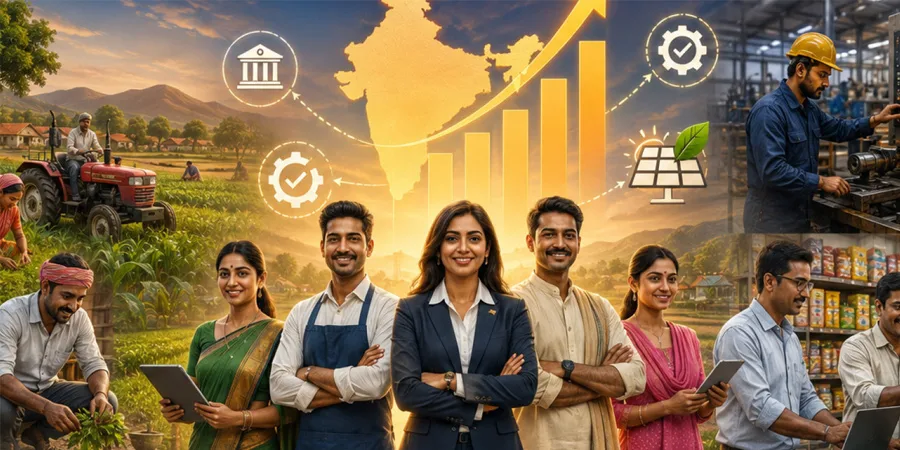
NEW DELHI: Micro, Small and Medium Enterprises (MSMEs) play a vital role in economic development of the country. They promote entrepreneurship, generate employment, and support decentralised industrial growth. MSMEs are especially important for strengthening rural and semi-urban economies. Recognising this, the Government has introduced several initiatives, which aim to improve access to finance, encourage formalisation, strengthen market linkages and promote digital integration of small enterprises.
MSMEs contribute about 31.1 per cent to the country’s GDP, account for 48.58 per cent of total exports, and generate around 35.4 per cent of manufacturing output. The sector encompasses more than 7.47 crore enterprises and provides livelihoods to approximately 32.8 crore people.
A large share of these enterprises operates in rural and semi-urban areas. They support local value chains, promote non-farm employment, and contribute to regional economic development. Given their importance, strengthening MSMEs in rural and semi-urban areas is critical. This helps promote inclusive growth, improve productivity, and integrate small enterprises into national and global supply chains.
Many of the MSMEs exist as unregistered and informal enterprises. It is necessary to formalise them so that they can avail credit and other support. In recent years, formalisation has accelerated through digital registration platforms. As of March this year, over 7.9 crore MSMEs and informal micro enterprises have been registered.
Timely, affordable credit
The Government has put in place multiple credit and financial support mechanisms to address this gap.
Credit Guarantee Scheme (CGS): The scheme facilitates the flow of collateral-free and third-party guarantee-free credit to MSEs. It enables first-generation and underserved entrepreneurs to access institutional finance.
Self-Reliant India (SRI) Fund: It was launched to provide Rs 50,000 crore in equity support to MSMEs through a Fund of Funds mechanism. The Fund comprises Rs 10,000 crore from the Government and Rs 40,000 crore to be raised through private equity and venture capital funds.
Emergency Credit Line Guarantee Scheme: The ECLGS supports eligible MSMEs and business enterprises in meeting their operational liabilities. It is also aimed at helping them restart their businesses in the context of Covid-19 disruptions.
Legal, institutional support
Timely realisation of payments for goods and services is essential for the financial stability and operational continuity of MSMEs. These enterprises often operate with limited working capital. Recognising this, the Government has established a robust legal and institutional framework to address this issue.
MSMED Act, 2006: The Micro, Small and Medium Enterprises Development (MSMED) Act, 2006 provides statutory protection to Micro and Small Enterprises against delayed payments. Under the Act, buyers are mandated to make payments to MSEs within 45 days of acceptance of goods or services.
SAMADHAAN portal: Launched in October 2017, it provides a technology-enabled mechanism for MSEs to file and monitor delayed payment applications online. Cases are automatically referred to the respective MSEFC for adjudication.
A dedicated sub-portal was created in June 2020 to track payment dues from Central Ministries, Departments, and Central Public Sector Enterprises (CPSEs).
Building on this framework, the Ministry of MSME launched an Online Dispute Resolution (ODR) portal in June last year. The portal provides end-to-end digitised resolution of delayed payment cases. It further reduces the time and cost involved in redressal for MSEs across the country.
Priority sector inclusion
A large proportion of India’s micro enterprises operate outside the formal economic system, without official registration or documented financial history. This structural informality limits their access to institutional credit, Government schemes, and formal markets. The Government has undertaken targeted measures to bring these enterprises within the formal fold.
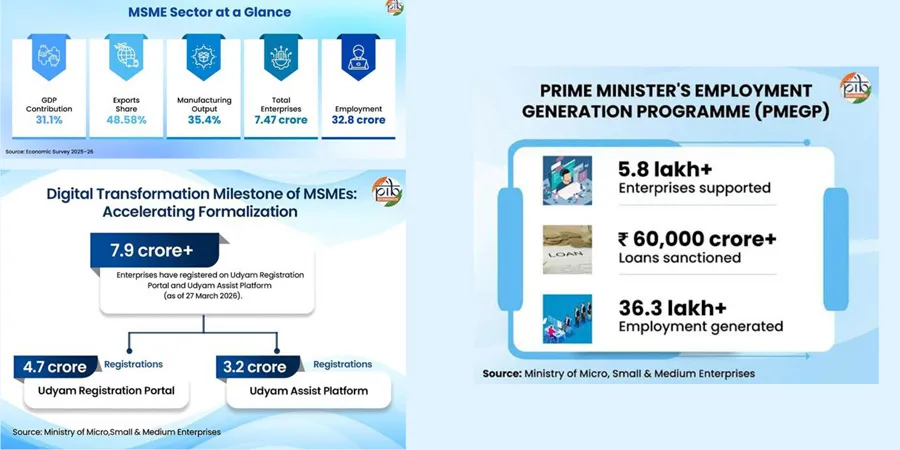
Udyam Assist Platform: Launched in January 2023, the UAP brings Informal Micro Enterprises (IMEs), lacking formal registration, into the formal financial system. It enables such enterprises to register and access Priority Sector Lending benefits, facilitating their integration into the institutional credit ecosystem.
Inclusion of traders: From July 2021, retail and wholesale traders have been included within the ambit of MSMEs through revised Government’s guidelines. This has enabled enterprises to register on the Udyam Registration Portal and avail benefits under Priority Sector Lending (PSL) norms.
Transition support: To avoid penalising growth, the Government allows non-tax benefits to continue for three years. This applies in cases where an MSME graduates to a higher classification category. This measure removes a key disincentive for smaller enterprises to scale up their operations.
Digitalisation initiatives
Digital integration is increasingly central to MSME competitiveness. It enables enterprises to access Government procurement markets, obtain faster payment realisation, streamline compliance, and expand their customer base. The Government has built a comprehensive ecosystem of digital platforms to support MSMEs at each stage of their operational lifecycle.
Under the Digital India programme, the Government has focused on strengthening digital infrastructure. It also aims at delivering governance and services on demand, and promoting digital empowerment of citizens and enterprises. For MSMEs, digital enablement translates into improved market access, better financial inclusion, and enhanced ease of compliance.
A wide ecosystem of digital platforms has been developed to support MSME formalisation, financing, market linkages, and dispute resolution. These include: Udyam portal, Government e-Marketplace (GeM), Trade Receivables Discounting System (TReDS), MSME Champions Portal, MSME SAMBANDH, PMEGP portal, and PM Vishwakarma portal.
Given their importance, strengthening MSMEs in rural and semi-urban areas is critical. This helps promote inclusive growth, improve productivity, and integrate small enterprises into national and global supply chains.