




Deepak Dwivedi
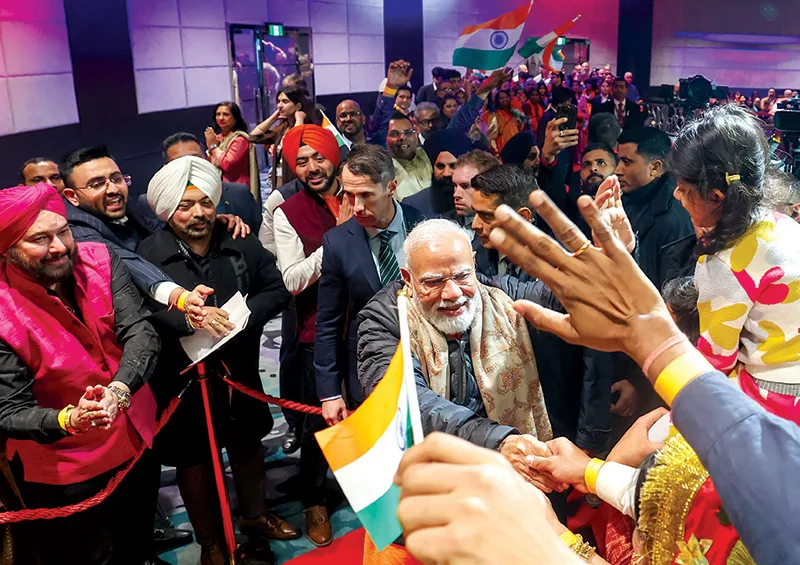
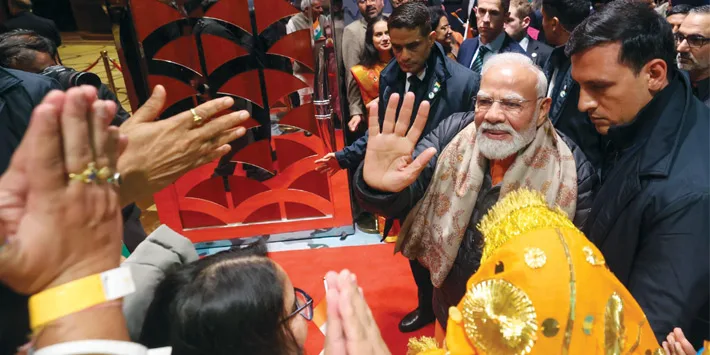
Prime Minister Narendra Modi told a 30,000-strong Indian community gathering at Melbourne’s Marvel Stadium that India is building a new manufacturing ecosystem “from chips to ships”, declaring that 12 years of the Make in India mission have turned the initiative into a global brand.
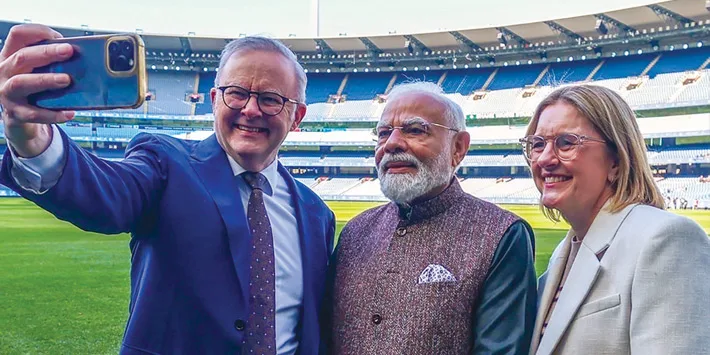
Addressing the diaspora on July 9, on the Australian leg of a six-day, three-nation tour of Indonesia, Australia and New Zealand, with Australian Prime Minister Anthony Albanese in attendance, PM Modi said Indian-made mobile phones, automobiles and defence equipment now command international recognition, and that the country’s defence sector today represents both capability and credibility on the global stage.
New golden chapter
The Melbourne address carried forward a message the Prime Minister has taken across the Indo-Pacific. In Jakarta, where the tour began, he told Indonesia’s Parliament that the India-Indonesia partnership was entering a “new golden chapter” as the two countries signed 20 agreements – among them cooperation on the BrahMos missile system, a marquee Make in India defence export, and Indian investment in manufacturing steel, nickel and rare-earth permanent magnets in Indonesia to strengthen critical mineral supply chains.
The manufacturing pitch drew a striking endorsement from Indonesian President Prabowo Subianto, who told PM Modi he had “copied many of your programmes” because what works for India’s hundreds of millions can work for Indonesia too – adding, with a smile that he was glad there was “no copyright” on India’s schemes.
The Prime Minister’s confidence rests on a decade of measurable achievements. Since its launch in September 2014, Make in India has helped attract cumulative FDI inflows of $667.4 billion between 2014 and 2024 – a 119 per cent jump over the previous decade – while manufacturing FDI equity rose 69 per cent to $165.1 billion.
India’s Ease-of-Doing Business ranking climbed from 142nd in 2014 to 63rd, merchandise exports touched $437 billion in FY2023-24, and manufacturing employment grew from 57 million to 64.4 million between 2017-18 and 2022-23. The Production Linked Incentive schemes have drawn Rs 1.32 lakh crore of investment and generated Rs 10.9 lakh crore of output.
Since its launch in September 2014, Make in India has helped attract cumulative FDI inflows of $667.4 billion between 2014 and 2024, while manufacturing FDI equity rose 69 per cent to $165.1 billion
Public sector backbone
Nowhere is the transformation more striking than in defence. Production has more than tripled from Rs 46,429 crore in FY2014-15 to a record Rs 1,50,590 crore in FY2024-25, while defence exports have surged from a few hundred crore to Rs 23,622 crore, reaching close to 100 countries.
Public sector undertakings have been the backbone of this surge. India today builds its own aircraft carriers, submarines, fighter jets, missiles and semi-high-speed trains – from Cochin Shipyard’s INS Vikrant, the nation’s first indigenously built aircraft carrier, to HAL’s Tejas fighters, Mazagon Dock’s submarines and the Vande Bharat trains rolling out of Indian factories.
The electronics story is equally compelling. India has turned from a net importer of mobile phones into a net exporter, with smartphone manufacturing among the sunrise sectors, the Prime Minister highlighted in Melbourne alongside semiconductors and communication technology.
Innovation engine
PM Modi also linked the manufacturing surge to India’s innovation engine, noting that the country has grown from a few hundred startups to more than two lakh – the world’s third-largest startup ecosystem – with hundreds working in advanced sectors such as defence and space.
With Make in India now in its 2.0 phase spanning 27 sectors and feeding into the Atmanirbhar Bharat and Viksit Bharat 2047 visions, the week’s addresses – from Jakarta’s Parliament to Melbourne’s Marvel Stadium – signalled that India’s manufacturing story is no longer just a domestic policy programme but a calling card abroad, one that, as the Prime Minister told the diaspora, is creating new opportunities for India’s global partners.