




Blitz India Business
NEW DELHI: India’s non-fossil capacity stands at 297.36 GW, closing on 300. The 2030 target is 500 GW of renewable capacity. The remaining distance is not an engineering problem — the panels and turbines are procurable. It is a financing and offtake problem.
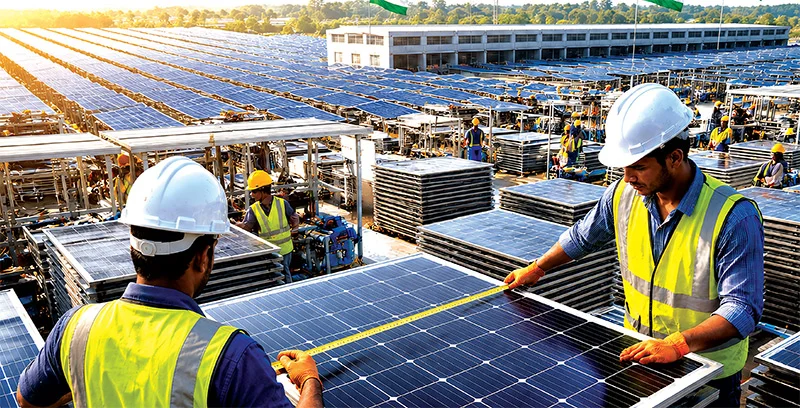
Start with where the build actually is. Renewable capacity reached 288.58 GW as of June 2026, led by 162.15 GW of solar, and non-fossil capacity — which includes large hydro and nuclear — was 297.36 GW. India ranks third globally in installed renewable capacity. Getting from roughly 289 GW of renewables to 500 by 2030 means adding something in the region of 210 GW in four and a half years, which is more than India’s entire renewable fleet took its first two decades to assemble. That rate of addition is physically achievable; module supply, land aggregation and construction capability have all scaled. What has not scaled at the same rate is the two things that decide whether a project reaches financial close: a creditworthy buyer at the other end of a twenty-five-year contract, and grid capacity to evacuate the power when the sun is up.
Cheap to build, hard to finance: the levelised cost of Indian solar is among the lowest in the world. The binding constraint has moved downstream — to offtake, transmission and storage.
Solar is now the cheapest electricity India has ever built. It is also the hardest to sell at three in the afternoon and impossible to sell at nine at night.
At a Glance
• Renewable capacity, June 2026: 288.58 GW
• Solar within that: 162.15 GW
• Non-fossil capacity: 297.36 GW — approaching the 300 GW mark
• 2030 targets: 500 GW of renewable capacity; about 280 GW of solar
• Global position: India ranks third worldwide in installed renewable capacity
• The gap: roughly 210 GW of additional renewable capacity in about four and a half years
• Where the constraint has moved: from cost of generation to offtake creditworthiness, transmission and storage
The offtake question is the one that determines the cost of capital, and therefore the tariff. A solar developer borrows against a twenty-five-year power purchase agreement; the interest rate on that debt reflects the lender’s confidence that the distribution utility at the other end will pay on time for twenty-five years. Where that confidence is weak, the developer pays more for debt, and every additional percentage point of financing cost feeds directly into the tariff the consumer eventually pays. This is why distribution reform is not a separate agenda from the energy transition — it is the same agenda. A financially sound utility is, in effect, a subsidy on every renewable project in its state, delivered through the interest rate rather than the budget.
The second constraint is time-of-day, and it is where the next decade’s engineering and money will both go. Solar generates in the middle of the day; Indian demand peaks in the evening. Bridging those hours requires storage — batteries, pumped hydro — and transmission that can move surplus from a sunny state to a shortfall elsewhere in real time. Both are capital-intensive, and both are being procured. The constructive path is visible and India is already on it: contract for round-the-clock and firm-dispatchable renewable supply rather than raw capacity, so that developers are paid for reliability instead of gigawatts; build transmission ahead of generation rather than behind it, because a line takes longer to permit than a solar farm takes to build; and keep widening the pool of capital, which is one reason GIFT City’s growth into a jurisdiction with $111 billion in assets matters to a wind project in Gujarat. Capacity is the headline. Bankability is the constraint. Whether India lands 500 GW by 2030 will be settled in credit committees, not on construction sites.