Blitz India Business
NEW DELHI: An aircraft lease is a financing instrument that happens to fly. Its price is set by three things — how certain the lessor is of getting the asset back, what the tax treaty says, and what currency the rent is in — and on all three India has, until recently, been the wrong side of somebody else’s arrangement. The first meeting of the High-Level Committee on Aircraft Leasing and Financing, held on 2 September, was an attempt to move all three at once.
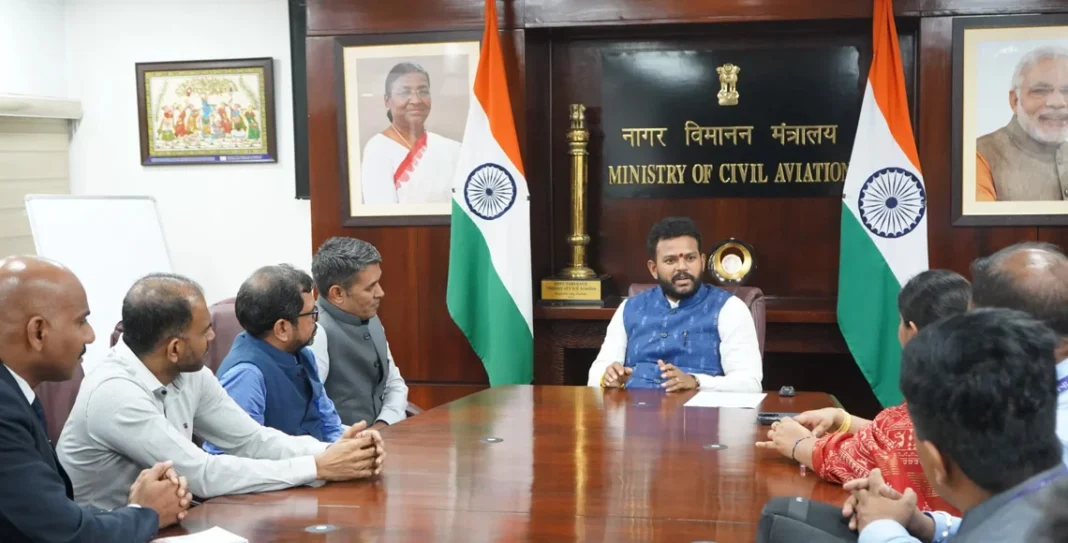
The first meeting of the High-Level Committee on Aircraft Leasing and Financing, held in New Delhi, on 2 September 2026. Photograph from the Ministry of Civil Aviation’s own release, static.pib.gov.in.
The composition is the first thing a financial reader should look at. The chair was the Union Minister of Civil Aviation, Shri Ram Mohan Naidu; the table held the Ministry’s Secretary, Shri Samir Kumar Sinha, and Additional Secretary, Shri Puneet Kansal, with the Ministry of Finance, the Department of Commerce, the Directorate General of Civil Aviation, the Reserve Bank of India, the International Financial Services Centres Authority and industry associations. Nothing on the agenda could have been settled by the aviation ministry alone: two of the five items are tax, one is banking and one is a bilateral treaty.
The Story so far
Four hundred and twenty-two assets have been leased through the International Financial Services Centre, of which 250 are aircraft and 87 are engines, and 474 leasing agreements have been signed. Those are the Minister’s figures. Two ratios fall out of them and neither is in the release.
First, 474 agreements against 422 assets is 1.12 agreements per asset. For a leasing centre that is the single most diagnostic number available, because it separates a jurisdiction where an aircraft is registered once from a jurisdiction where an aircraft is traded. Second, 250 aircraft plus 87 engines is 337, which leaves 85 assets — a fifth of the book — unaccounted for in the release’s own description. Ground equipment, simulators, spares packages and auxiliary power units are all leasable through such a centre; the release does not say which, and this desk will not guess.
Blitz Data Card : The IFSC Aircraft Book, And What It Implies
| Metric | Value |
|---|---|
| Assets leased through IFSC, cumulative | 422 |
| Aircraft | 250 |
| Engines | 87 |
| Neither aircraft nor engine (derived here) | 85 |
| Leasing agreements signed | 474 |
| Agreements per asset (derived here) | 1.12 |
| Indian carriers’ fleet on lease | more than 85% |
| Composition of the 85 residual assets | NOT STATED |
THE COMPARISON. Aircraft 250 ▮▮▮▮▮▮▮▮▮▮▮▮▮▮▮▮▮▮▮▮▮▮▮▮▮ · Engines 87 ▮▮▮▮▮▮▮▮▯ · Residual 85 ▮▮▮▮▮▮▮▮▯ (one block = ten assets). Aircraft exceed engines by 187.4 per cent, derived here as (250−87)÷87.
BLITZ CALCULATION. 250 + 87 = 337; 422 − 337 = 85 assets, 20.1 per cent of the book, whose class the release does not state. 474 ÷ 422 = 1.12 agreements per asset, the re-lease ratio. 365 ÷ 45 = 8.1 airports a year at the stated rate of one every forty-five days.
WHAT INDIA GAINS. Lease rentals on eighty-five per cent of a growing fleet are, today, largely a payment abroad; every basis point of that flow rebooked into an Indian centre is fee income, tax and skilled employment retained in India.
The Ireland question
The most consequential line in the release is the shortest: the Committee discussed the possibility of renegotiating the Double Taxation Avoidance Agreement framework with Ireland. Ireland has been the world’s aircraft-leasing centre since the 1970s, and its position rests less on geography than on a treaty network that makes lease rentals cheap to route. A jurisdiction competing with it has to reach either the same treaty outcome or a domestic substitute for it. That India has put the question on a first agenda rather than a fifth is itself information.
The second item, clarity on the applicability of the General Anti-Avoidance Rule, is the one lessors’ counsel will read first. A lessor is not asking for a concession; it is asking for certainty that a structure approved today will not be characterised differently in five years. Certainty, in leasing, is a price.
“With more than 85% of the fleet of Indian carriers being leased, he emphasized the significance of continued engagement with stakeholders to strengthen the leasing ecosystem.”
The sequence, in the Minister’s own account
• First Aircraft Leasing Summit held at GIFT City
• Industry asked for ratification of the Cape Town Convention
• Government enacted the Protection of Interests in Aircraft Objects Act
• At the second summit, industry asked for a High-Level Committee
• The Committee held its first meeting on 2 September 2026
Rupees, and bank credit
Rupee-denominated financing for aircraft would change the risk arithmetic of every Indian airline’s balance sheet. A dollar lease leaves the carrier long on fuel costs and short on currency at the same time, and a bad quarter in the exchange rate arrives as a bad quarter in the fare. The Minister also suggested exploring greater allocation of bank credit to the aircraft sector, and joint ventures for technical and skill development in leasing — the second of which is the unglamorous constraint, because a leasing centre needs technical staff who can inspect, value and remarket an airframe, and those people are today mostly employed elsewhere.
A constructive suggestion. The Committee’s own conclusion was a coordinated and time-bound approach. Time-bound is a claim that can be verified only against a published clock. A quarterly disclosure by the International Financial Services Centres Authority of assets added, agreements written and assets re-leased would let the market judge the pace for itself, and would put the re-lease ratio — the number that actually distinguishes a hub from a registry — into the public record where an investor can see it move.


