




Blitz India Business
NEW DELHI: Merchandise exports of $44.24 billion in July are the highest India has recorded in any July, and 15.4 per cent above the previous July record. The import line grew faster. Both facts belong in the same sentence.
Commerce Ministry data for July 2026 puts merchandise exports at $44.24 billion against $36.98 billion in July 2025 — growth of 19.63 per cent. The previous July peak, $38.34 billion, had stood since 2022; the new figure exceeds it by 15.4 per cent. Services exports were $35.89 billion against $33.74 billion. Overall exports of goods and services therefore reached $80.14 billion, up 13.32 per cent on $70.72 billion a year earlier.
Imports rose to $95.16 billion from $82.16 billion, growth of 15.82 per cent. Since imports grew 2.5 percentage points faster than exports on a base that was already $11.4 billion larger, the overall deficit widened to $15.03 billion from $11.44 billion — an increase of 31.3 per cent, which is the headline number most outlets led with. The arithmetic is worth doing rather than reading: a deficit widening while exports set a record is a statement about the import bill, not about export competitiveness.
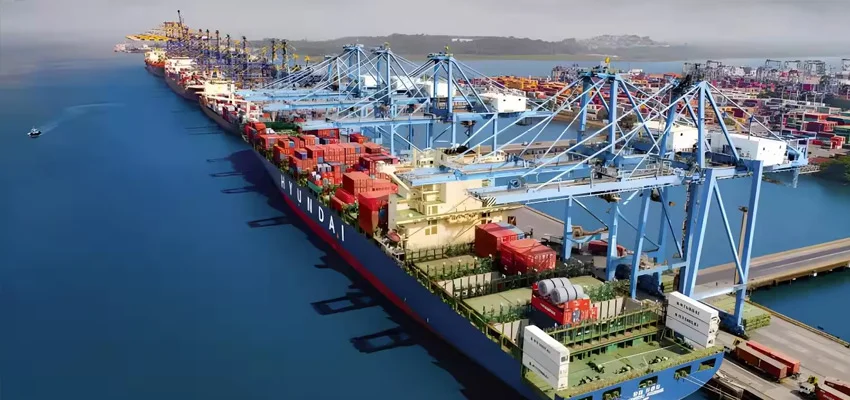
The month that set the record: Jawaharlal Nehru Port. India’s merchandise exports reached $44.24 billion in July 2026, 15.4 per cent above the previous July record of $38.34 billion set in 2022.
A deficit widening in the same month exports set a record is not a verdict on competitiveness. It is a verdict on the energy bill — and it is the same number that shows up as a 19-month high in retail inflation.
At a Glance
• Merchandise exports, July 2026: $44.24 bn, up 19.63% YoY
• Previous July record: $38.34 bn (2022) — exceeded by 15.4%
• Services exports: $35.89 bn vs $33.74 bn
• Overall exports: $80.14 bn, up 13.32%
• Overall imports: $95.16 bn, up 15.82%
• Overall deficit: $15.03 bn vs $11.44 bn — wider by 31.3%
• April-July 2026-27 exports: $316.42 bn, up 13.16%
• Live trade agreements in July: US 18% tariff line, India-UK CETA (from 15 July), India-UAE CEPA
Three tariff events sit behind the export number and they landed close together. The United States cut its reciprocal tariff on Indian goods to 18 per cent from 25 in February and removed a further 25 per cent Russian-oil penalty by Executive Order. The India-United Kingdom Comprehensive Economic and Trade Agreement entered into force on 15 July, so July is its first month of operation. And India-UAE trade under CEPA crossed $101.25 billion in 2025-26, the second consecutive year above $100 billion, with non-oil trade now close to two-thirds of the total. July was the first month in which all three were simultaneously live.
For the four months of 2026-27 to date, overall exports stand at $316.42 billion against $279.63 billion, growth of 13.16 per cent — almost exactly the July rate, which suggests July was a strong month within a consistent trend rather than a one-off spike. That consistency is the more useful signal for anyone modelling the year.
The import side deserves its own reading. Retail inflation for July came in at 4.45 per cent, a 19-month high, with the Reserve Bank noting in its August policy that the rise was driven largely by food and fuel. Energy is simultaneously the largest single import line and the principal driver of the domestic price level, which means the widening deficit and the rising CPI are substantially the same story told through two different datasets. The Monetary Policy Committee held the repo rate at 5.25 per cent on 5 August and raised its FY27 growth forecast to 6.7 per cent, projecting inflation to peak in the third quarter before easing.
The forward-looking question for exporters is composition rather than volume. Record tonnage into markets that pay modest unit prices is a weaker position than steady volume into markets that pay well — a pattern visible in miniature in India’s newly-counted makhana trade, where three markets take 77 per cent of shipments at the lowest realisations in the book. The constructive step available now is destination-wise unit-realisation reporting alongside the monthly headline, so the trade can see where value, not just volume, is being added.
What the July print establishes is capacity. India can move $44 billion of goods in a month when the tariff environment permits it. The next four prints will show whether that is a level or a peak.