





Blitz India Business
NEW DELHI: The Ministry of Electronics and Information Technology notified a ₹62,500 crore Mobile Phone Manufacturing Scheme on 21 August, running FY27 to FY31. The outlay is the second-largest ever committed to a single electronics scheme in India. The design is the more consequential part: the two ladders in it do not pay the same, and the gap between them is where the policy intent sits.
Target Segment 1 is large-scale manufacturing. The incentive band is 2.25% to 5%, differentiated by year and scale. Entry requires ₹10,000 crore of turnover in FY26; an existing brand must then sustain ₹5,000 crore of annual sales and a new brand must reach ₹10,000 crore. Target Segment 2 is reserved for Indian brands. The base incentive is 5%, with a further 3% for Indian design and research and development. Entry requires ₹1,000 crore of turnover in FY26 — a tenth of the first segment’s threshold — plus more than 51% Indian shareholding, Indian management, and Indian intellectual property, trademark and R&D. Both segments can add up to 1.5% for domestic sourcing, gated at a minimum of 25% localisation. Segment 2 applicants get a one-year gestation period.
At full stack the Indian-brand ladder pays 9.5% and the large-scale ladder pays 6.5%, a three-point spread the release nowhere states and that is the whole of the policy.
AT A GLANCE
● ₹62,500 crore — scheme outlay, FY27 to FY31 (Ministry of Electronics and Information Technology, 21 August 2026)
● 2.25% to 5% — Target Segment 1 incentive band, large-scale manufacturing (same release)
● 5% + 3% — Target Segment 2 base incentive and Indian design and R&D top-up (same release)
● up to 1.5% — domestic sourcing bonus in both segments, gated at 25% localisation (same release)
● ₹10,000 crore against ₹1,000 crore — FY26 turnover thresholds, Segment 1 against Segment 2 (same release)
● more than 51% — Indian shareholding required to enter Segment 2 (same release)
● about ₹39 lakh crore — cumulative production the ministry projects over the scheme tenure (same release)
● about 60,000 — direct employment the ministry projects (same release)
WHERE THE MONEY ACTUALLY GOES
A production-linked incentive pays a percentage of incremental sales of eligible goods manufactured in India. The ceiling matters less than the rate, because the rate decides who applies. On the published rates, a contract manufacturer assembling handsets for a global brand takes 5% at the top of the band plus 1.5% for sourcing, at 6.5%. An Indian brand designing its own device, holding its own trademark and doing its own R&D takes 5% plus 3% plus 1.5%, at 9.5%.
Three points of incentive on a category that competes on price is not a rounding difference. It is a per-unit subsidy gap that widens with every device shipped, and in a market where handset assembly margins are thin it is large enough to decide whether a domestic brand builds its own or has someone else build for it.
THE GATES, AND WHO THEY EXCLUDE
The ₹1,000 crore FY26 turnover floor for Segment 2 is low enough to admit the surviving Indian handset brands and high enough to exclude a startup. The 51% shareholding test is the binding one. It disqualifies any Indian-founded brand that has taken control-level foreign capital, which is a substantial part of the domestic consumer-electronics cap table, and it cannot be met by restructuring after the fact without changing who owns the company.
The 25% localisation gate on the 1.5% sourcing bonus is where component policy meets handset policy. A bonus available only above a quarter of value sourced domestically is a pull on the display, battery, camera-module and enclosure supply chain rather than on final assembly, which is where the previous decade’s incentives concentrated.
WHAT THE PROJECTIONS ARE AND ARE NOT
₹39 lakh crore of cumulative production and about 60,000 direct jobs are ministry projections over five years against output that has not occurred. ₹62,500 crore is a ceiling payable against future production, not an amount disbursed or committed to any applicant. The release carries no application window, no year-wise disbursal profile and no cap per applicant, and until those are notified the scheme cannot be modelled at company level.
WHAT TO WATCH
Three things settle whether the design works. First, the application window and whether Segment 2 fills — if fewer than a handful of Indian brands clear the 51% and ₹1,000 crore tests together, the carve-out is a rate on paper. Second, whether the 25% localisation gate is measured on bill-of-materials value or on a deemed basis, because the two produce very different answers on a device whose costliest components have no domestic source. Third, the disbursal record of the previous handset scheme, which is the only evidence available on how much of a notified ceiling reaches an applicant’s account.
BLITZ RECOMMENDS
Publish the Segment 2 eligibility list once applications close, and publish the localisation methodology with it. A rate reserved for Indian brands is only credible if the market can see which companies qualified and on what measurement, and the absence of that disclosure under earlier schemes is the reason their headline outlays and their actual disbursals were argued over for years rather than settled. A quarterly disbursal statement, applicant by segment, would settle the same question for this scheme before it can be asked.
Banks skip the VRRR, RBI doubles the offer
NEW DELHI:The Reserve Bank notified ₹1,50,000 crore for a three-day variable rate reverse repo on 21 August and received bids of ₹95,970 crore — a bid-to-cover of 0.64, with ₹54,030 crore of the notified amount left untaken. All bids were accepted, and the cut-off and the weighted average both printed at 5.24%. By the evening the Bank had notified a seven-day operation of ₹2,50,000 crore for 24 August, reversing on 31 August.
A variable rate reverse repo is the Bank absorbing surplus rupees from banks for a fixed term at a rate the auction sets. A bank bids only if the term rate beats leaving the same money in the standing deposit facility overnight. On 20 August, with the three-day paper on offer at 5.24%, ₹1,10,597 crore was sitting in the standing deposit facility at 5.00% — banks giving up 24 basis points for the ability to have the money back the next morning.
That is the mechanism behind the undersubscription, and behind the response. Having failed to place a three-day tenor, the Bank did not repeat it: it came back with a tenor more than twice as long and an amount two-thirds larger, reaching to term out the surplus past month-end rather than roll it nightly.
The scale of the surplus is the context. On 20 August the Bank’s operations produced net absorption of ₹2,60,599 crore, and net absorption including outstanding positions stood at ₹3,50,057.94 crore, against marginal standing facility borrowing of ₹43 crore. Overnight rates traded below the 5.25% repo rate throughout: call money at a weighted average of 5.16%, triparty repo at 5.05% on ₹4,41,475 crore and market repo at 5.01% on ₹1,79,010.04 crore.
The dating needs care. The money market operations release is dated 21 August but reports 20 August, and no operations release for 21 August itself had published as of the morning of 22 August.
Fifty-year bond clears at 7.5674%, no devolvement
NEW DELHI:The Centre raised the full ₹28,000 crore notified at the government stock auction of 21 August, and devolvement on primary dealers was nil on both papers, the Reserve Bank reported.
The fifty-year 7.43% GS 2076 drew competitive bids of ₹26,354 crore against ₹11,000 crore on offer, a bid-to-cover of 2.4, and cleared at a cut-off price of ₹98.22 for an implied yield of 7.5674%. The weighted average was ₹98.38 at 7.5548%, a tail of 1.3 basis points. The 7.06% GS 2041 drew ₹43,115 crore against ₹17,000 crore and cleared at ₹99.93 for 7.0668%, with a weighted average of ₹99.96 at 7.0635%. Partial allotment did the rationing: 60.2602% on 20 bids at the 2041 cut-off, 48.5333% on a single bid at the 2076 cut-off.
The fifty-year clearing at 7.5674% against a 7.43% coupon means the paper sold at a discount, and puts the ultra-long about 50 basis points above the 2041. Underwriting priced that risk in advance: at the additional competitive underwriting auction the same morning, dealers took 0.88 paise per ₹100 on the 2076 against 0.59 paise on the 2041, half as much again to backstop the long bond, and in the event were not called on.
Nil devolvement is not the same as demand at any price. Nearly half the marginal bid on the fifty-year was rationed away, which is the Bank declining to buy the remaining demand by conceding more yield.
Washington sets stacked duties on Kerala extract
NEW DELHI:The United States Department of Commerce published final affirmative anti-dumping and countervailing duty determinations on oleoresin paprika from India on 21 August, in cases A-533-938 and C-533-939. The two duties stack as cash deposits at the border.
Countervailing rates: Synthite Industries 25.42%, Mane Kancor Ingredients 18.67%, all others 21.90%. Anti-dumping margins: Synthite 5.78%, Mane Kancor 4.24%, all others 5.08%. The period of investigation in both cases ran 1 April 2024 to 31 March 2025. Commerce values 2024 United States imports of the product from India at $56,441,682, in its preliminary countervailing duty fact sheet of 30 January 2026.
Combining the two tracks is arithmetic Commerce does not publish, and the true liability depends on whether export subsidies are offset against the dumping margin. Taken at face value the two Kerala respondents face stacked rates of about 31% and about 23%.
The petition, filed by the single American producer Rezolex of Las Cruces, alleged margins of 235.82% to 284.83%. The final dumping figures are 4.24% to 5.78%. In this case the allegation and the determination are two different things, and it is the determination that the border collects on.
No order has issued. The United States International Trade Commission must vote on material injury within 45 days of the 21 August determination; a negative vote terminates the proceeding and refunds all deposits. Commerce separately found critical circumstances for Synthite alone on the subsidy side, allowing retroactive reach to entries before the preliminary determination.
One Indian flange maker at 50.72%, the rest at 0.60%
NEW DELHI:The United States Department of Commerce published final results of the anti-dumping administrative review on stainless steel flanges from India on 20 August, case A-533-877, for the period 1 October 2023 to 30 September 2024. The review split the Indian industry eighty-four to one.
Chandan Steel came out at 0.60%. The Viraj group — BFN Forgings, Viraj Alloys, Viraj Forgings, Viraj Impoexpo, Viraj Profiles and the German affiliate Flanschenwerk Bebitz — came out at 50.72%. Producers not selected for individual review take Chandan’s 0.60%. The all-others cash deposit rate from the original investigation, 7.00%, continues for exporters outside the review.
An administrative review is the annual true-up of an existing duty order: Commerce recalculates the margin for the year just past, and that rate becomes both the assessment rate on those entries and the going-forward cash deposit rate. A margin of this size in a review is frequently the product of adverse facts available, the rate Commerce applies where a respondent is found not to have cooperated fully with its questionnaires, rather than a finding of selling at half below fair value. The published notice does not state the basis, and no account from the companies concerned was available to the desk at the time of filing.
At 0.60% Chandan is above the 0.5% de minimis threshold, so the rate is assessable rather than zero.
The competitive effect inside India is as large as the trade effect outside it. Stainless flanges are a Maharashtra and Gujarat forging export, and an eighty-four-fold rate spread between two Indian mills selling the same product into the same market gives American importers a straightforward reason to switch supplier.
India named in five-country hydraulics petition
NEW DELHI:The United States Department of Commerce published notice on 20 August that it has extended by twenty days its deadline for deciding whether newly filed anti-dumping and countervailing duty petitions on certain linear hydraulic cylinders and parts are adequate to initiate. The new date is 8 September.
The petitions were filed on 29 July by the Hydraulic Cylinders Fair Trade Coalition and name five countries at once — Canada, China, India, the Republic of Korea and Mexico. Eight case numbers have been assigned, of which A-533-952 and C-533-953 are India’s. The statutory twenty-day adequacy deadline had fallen on 18 August; Commerce says it needs more time to analyse industry support, the test of whether enough of the American domestic industry actually backs the petition.
Nothing has been found against any Indian exporter. There is no rate, no margin and no import value in the notice, and initiation may not follow. What the notice establishes is the filing itself and the bracketing: India appears in the same petition as China, which is the pattern petitioners increasingly use to close the routes by which suppliers in third countries pick up business displaced from Chinese sources.
Linear hydraulic cylinders are the actuators inside excavators, tippers, tractors and material-handling equipment, and India’s supply base for them sits in Pune, Coimbatore, Rajkot and Faridabad. 8 September is the date on which this either becomes an investigation or does not.
Land-border easing draws ₹4,895.65 crore in 111 days
NEW DELHI:Twenty-nine investments with a proposed value of ₹4,895.65 crore have been reported under the revised framework for foreign investment carrying land-bordering-country ownership, counted to 20 August, the Ministry of Commerce and Industry said on 21 August. The framework has been in force since 1 May, so the figure covers 111 days and runs at about ₹1,300 crore a month.
The instrument is Press Note 2 of 2026 with the accompanying amendment to the Foreign Exchange Management (Non-debt Instruments) Rules, 2019, notified on 1 May. It allows non-controlling land-bordering-country ownership of up to 10% through the automatic route, replacing the Press Note 3 of 2020 requirement that every such case go for prior government approval.
The sectors reported are information technology, artificial intelligence, information and communication, manufacturing, pharmaceuticals, data centres and transport services. The source jurisdictions are Mauritius, the United States, the Republic of Korea, Japan, Singapore, Luxembourg and the Cayman Islands — none of them a land-bordering country. What the 10% carve-out has released is fund and holding-company capital that carried a limited-partner interest of 10% or less from a land-bordering country somewhere in the chain, not strategic capital from one.
₹4,895.65 crore is roughly $555 million at prevailing rates and is proposed rather than deployed investment. Against total foreign direct investment it is a small number; against the deal flow that had been stalled at the approval stage since 2020 it is the first measurable release.
Reserves at $716.9 billion, but gold is the gain
NEW DELHI:Foreign exchange reserves stood at $716,907 million in the week ended 14 August, up $9,905 million on the week, the Reserve Bank reported on 21 August. Foreign currency assets rose $7,225 million to $581,851 million, gold rose $2,679 million to $111,417 million, special drawing rights fell $5 million to $18,740 million and the reserve position in the International Monetary Fund rose $5 million to $4,899 million.
The composition over twelve months is where the reading changes. Total reserves are up $21,801 million on the year. Gold within them is up $25,750 million and foreign currency assets are down $4,052 million. The entire annual increase is gold revaluation, and the dollar leg has shrunk beneath it.
For an intervention question that distinction is the whole answer. Foreign currency assets are the sellable leg; gold is not sold to steady a currency. A reserve that grows on the gold line is larger against import cover and no larger against the screen.
The Reserve Bank marks the series provisional, and its own footnote records that foreign currency assets exclude its holdings of special drawing rights and its contribution to the funding of Nexus Global Payments. The data are as on 14 August and were published on 21 August, a week behind the market.
The same supplement puts scheduled commercial banks’ aggregate deposits at ₹2,69,41,367 crore as on 31 July, up 10.2% over twelve months and ₹6,60,688 crore over the fortnight, and bank credit at ₹2,20,78,095 crore, up 10.0% over twelve months and ₹3,43,420 crore over the fortnight. Deposit growth is running 20 basis points ahead of credit growth.
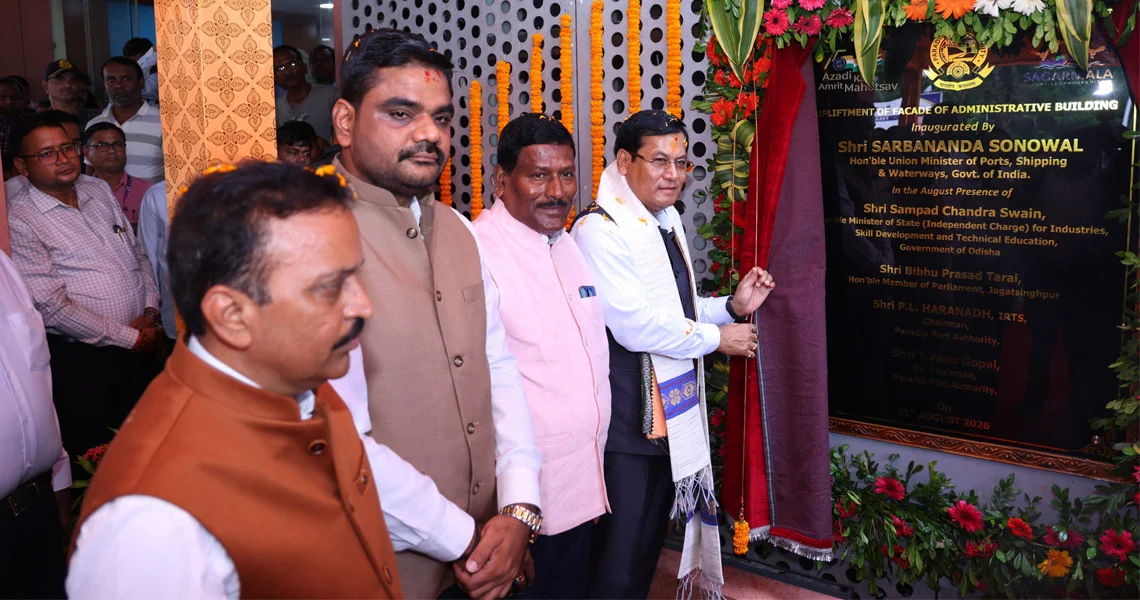
Paradip signs ₹1,580.36 crore of berth concessions
NEW DELHI:Paradip Port signed three build-operate-transfer concession agreements worth ₹1,580.36 crore on 21 August, covering 23 million tonnes a year of mechanised handling capacity, the Ministry of Ports, Shipping and Waterways said. The same day it commissioned seven projects worth ₹427.80 crore, of which ₹352 crore bought an 18.5-metre deep-draft capability.
The three concessions are a 5 million tonne South Quay at ₹498.69 crore, an 8 million tonne multipurpose berth at ₹630.67 crore and a 10 million tonne captive CQ-III berth at ₹451 crore. Under a build-operate-transfer contract the private concessionaire finances and installs the equipment and recovers it from handling charges across the concession term, so none of the ₹1,580.36 crore is a budget outlay and none of the 23 million tonnes exists yet.
That distinction governs the arithmetic. ₹427.80 crore is commissioned; ₹1,580.36 crore is contracted. The two should not be summed. Berth mechanisation at the port stands at 80% against a 2030 target of 100%, and these three concessions are the bulk of the remaining fifth.
The commissioned package also carried a ₹24.89 crore second Atharbanki bridge of 500 metres and three lanes, a ₹15.50 crore vessel traffic management system, ₹20 crore of piped natural gas to 546 residential quarters, a ₹12.18 crore administrative building upgrade and a ₹2.10 crore sports hostel.
The draft is what the freight market will price first. At 18.5 metres a fully laden capesize carrier can come alongside without lightering, which removes a transfer step and several days from the landed cost of every tonne of imported coking coal moving to eastern India’s steel plants.