




BRICS wants to turn economic weight into trade power
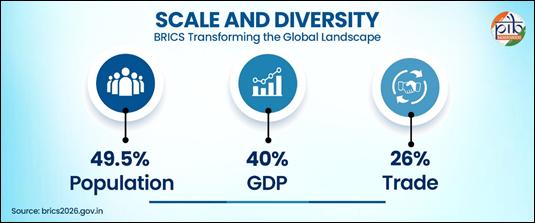
New Delhi, 12 September The Press Information Bureau’s research backgrounder on BRICS, posted on 10 September 2026, puts the eleven-member grouping at 49.5% of world population, 40% of global GDP and 26% of global trade.
Blitz has recomputed the relationships. The trade share is 0.525 of the population share. It sits 14.0 percentage points below the output share. And output per unit of population share works out at 0.808 — that is, BRICS produces slightly less output than its head-count share would imply, but trades far less than either.
An economy that produces and does not trade is an economy leaving margin on the table. The 14-point gap is the commercial case for the year’s ministerial output, and it is worth listing what that output actually consists of, because each item is an instrument rather than a sentiment.
Members have confirmed in-principle approval of a BRICS agreement on cooperation and mutual administrative assistance in customs matters, aimed at faster clearance, lower transaction costs and trusted trade facilitation.
The heads of the national standards bodies have signed a memorandum on standardisation, covering the development and adoption of standards, quality infrastructure and the reduction of technical barriers to trade.
Alongside these sit a global value chain action plan for 2026-2030 with a technical council and a joint study, and a logistics supply-chain cooperation framework addressing fragmented chains, cargo and shipping services and localised assembly ecosystems.
Customs harmonisation and mutual recognition of standards are the two measures with the most direct effect on an Indian exporter’s working capital. A consignment held for a duplicate conformity test ties up cash for the duration; a mutual-recognition clause releases it. That is the transmission channel from a signed memorandum to a firm’s balance sheet, and it is short.
BRICS exports have grown 6.7 times
New Delhi, 12 September Commerce and Industry Minister Piyush Goyal told the BRICS Business Forum on 11 September 2026 that exports from BRICS countries rose from about $900 billion in 2003 to $6 trillion in 2024.
Blitz recomputes the implied growth: 6.67 times over 21 years, a compound annual rate of 9.45%. For comparison of order, that is a doubling roughly every seven and a half years, sustained across two decades that included a financial crisis and a pandemic.

The Minister said the chairship has been driven by more balanced trade among members and the expansion of trade in services. He said the Forum drew more than 2,000 business leaders and delegates, the largest ever held, and took up non-tariff barriers affecting global value chains, agriculture and agri-technology, services trade, women-led enterprises and the digital economy.
Services is where India’s comparative advantage inside this grouping is strongest and least exploited. The goods agenda — customs, standards, logistics — is well advanced. There is as yet no services chapter with anything like the same specificity: no mutual recognition of professional qualifications, no movement-of-persons commitments, no data-flow understanding.
For an Indian information-technology firm, an accounting practice or an engineering consultancy, a qualifications-recognition clause is worth more than a tariff schedule will ever be. It is the difference between billing from Bengaluru and being unable to staff a project in Jakarta.
iBRICS Summit brings $1 trillion investor firepower
New Delhi, 12 September
The inaugural iBRICS Summit on 12 and 13 September 2026 brings together more than 500 institutional investors, finance ministers and business leaders. Akashvani News reports that the sovereign wealth funds, pension funds and family offices attending manage a combined $1 trillion — about $2 billion each on average, by this desk’s computation.
The summit’s stated design is to connect sovereign capital with bankable infrastructure, energy and digital capacity projects across 21 member and partner states.
Anyone who has taken an Indian infrastructure proposal to a pension fund knows where this stalls. The fund is not short of money and is not hostile to the sector. It needs a concession agreement it recognises, a tariff it can model, a dispute mechanism it has seen before and a revenue history it can test. Assemble those four and the capital is available at a price; leave one out and no price clears.

The agenda also covers cross-border investment, non-dollar settlement, payment systems, the linking of national fast-payment systems such as India’s Unified Payments Interface and Brazil’s Pix, and interoperability between central bank digital currencies. The meeting is set against shifting trade patterns, tariff pressure and high dollar-clearing costs.
Green India Mission audit reveals cost per hectare
New Delhi, 12 September Public spending is finally judged on unit cost, and the Comptroller and Auditor General’s performance audit of the Green India Mission supplies one that had not been published before.
Report No. 4 of 2026, tabled in Parliament on 12 August 2026, records that ₹1,149.14 crore — 47.88% of the approved outlay — was received through budgetary support over the ten years from 2015-16 to 2024-25, and that afforestation interventions were made on 1,47,925.63 hectares across 16 sampled states and union territories.
Blitz divides the one by the other: about ₹77,684 of central budgetary support for every hectare treated. The report does not print this figure. It is the number a finance ministry needs when the 25 million hectare target adopted in 2021 comes up for costing, and on this unit cost alone that target implies an order of magnitude no current budget line approaches.
Two further ratios follow from the report’s own figures and reproduce exactly. Against the 2014 Cabinet approval of 2.8 million hectares, the 0.14793 million hectares treated is 5.28%. And the ₹1,149.14 crore received against the ₹2,000 crore Twelfth Plan outlay plus ₹400 crore of Thirteenth Finance Commission grants is 47.88%, which is what the auditor prints.
The audit’s financial-management recommendations are the ones a business reader should note, because they are about cash timing rather than policy. Of 68 annual plans of operation approved across the sampled states in that period, only six reached the Ministry before the start of their own financial year, and none of those six was approved before it began (para 3.3). The auditor recommends a fixed submission timeline and a region-wise plantation calendar with fund disbursement aligned to it.
The reasoning is agronomic as much as financial. A sapling planted outside its planting window does not survive, so money released late is not merely delayed money, it is money spent on plants that die. The recommendation at para 3.4 that states, state forest development agencies and forest development agencies hold to fund-release timelines follows directly from that.
The audit also records ₹3.50 crore of expenditure on flux towers in Madhya Pradesh and Chhattisgarh, built to quantify carbon sequestration and since idling for want of maintenance planning by the Indian Council of Forestry Research and Education, with a recommendation that they be operationalised at the earliest (para 4.10.2).
Those same two states are the only ones in the sample that assessed carbon sequestration at all during 2015-2025. The equipment and the intent were both there.
India-Russia set bigger investment target for 2030
New Delhi, 12 September Commerce and Industry Minister Piyush Goyal, addressing INNOPROM on 10 September 2026, called for an accelerated India-Russia economic and industrial partnership working towards $100 billion in bilateral trade and $50 billion in two-way investment by 2030.
A $50 billion two-way investment goal is the more demanding of the two and the more valuable. Trade volumes can be moved by a single commodity contract; investment stock cannot. It requires incorporated entities, transferred technology and people on payrolls, and it is far harder to reverse.
The relationship was reviewed at the leaders’ level in New Delhi on 11 September 2026, covering politics, trade and economy, defence, energy, space, skill mobility and people-to-people ties. The Russian President invited the Prime Minister to Russia for the 24th India-Russia Annual Summit, and the invitation was accepted, with dates to be settled by mutual convenience.
For Indian firms the question is which sectors carry the investment. Energy and defence are established.
Pharmaceuticals, agricultural machinery, information technology services and food processing are where an incremental dollar is most likely to find a return, and where an Indian promoter can take a controlling position rather than a supply contract.
Fintech growth must be matched by trust: Sitharaman
New Delhi, 12 September Finance Minister Nirmala Sitharaman told the Global Fintech Festival 2026 in Mumbai on 11 September 2026 that India should pursue technological innovation at scale without compromising human responsibility, safety and public trust. She said the demographic dividend is visible in the rapidly growing fintech ecosystem, and that India’s young generation was not waiting for opportunities.
Read as a business signal, that is guidance on where regulatory attention is going. Firms building on India’s public digital rails should expect the compliance cost of consumer protection to rise, and should price it in now rather than argue about it later.

A day earlier, on 10 September 2026, Communications Minister Jyotiraditya Scindia told the same festival that the fintech revolution is inseparable from the connectivity revolution, and pointed to artificial intelligence, quantum computing and quantum cryptography as the technologies shaping what follows.
Quantum cryptography from a communications minister is not decoration. A payments system of India’s volume has a migration problem coming, and the institutions that budget for post-quantum key management early will do it cheaply.
Markets end lower for third straight session
New Delhi, 12 September Domestic benchmarks were lower on 11 September 2026 in what Akashvani News reported as a third consecutive session of decline. When reports last came in the Sensex was down 55 points at 74,848 and the Nifty 53 points at 23,425, after both had pared steeper losses in the last hour.
The rupee depreciated 10 paise to close at 95.55 against the US dollar. In bullion, 24 carat gold fell 0.9% to ₹1,51,938 per 10 grams and silver dropped 2% to ₹2,28,920 per kilogram.
Silver falling at more than twice the rate of gold on the same session is the detail worth keeping. The two metals part company when industrial demand moves, and silver’s exposure to solar and electronics manufacturing now dominates its monetary character.
Overseas on the same day, South Korea’s Kospi fell nearly 1.8% and Japan’s Nikkei 225 dropped over 1.9%, while London’s FTSE 100 rose 0.6% and Germany’s DAX traded 0.7% higher when reports last came in.
Blitz records that the equity figures are intra-session levels as the broadcaster carried them, not a settled close, and that none of these are exchange settlement data. Any commercial use takes the settlement figure with its own settlement date.
ASSOCHAM wants BRICS success measured by result
New Delhi, 12 September The Associated Chambers of Commerce and Industry of India welcomed the Prime Minister’s vision for strengthening BRICS as a platform for cooperation and a stronger voice for the Global South, in a statement reported on 11 September 2026. ASSOCHAM President Nirmal K Minda framed the chamber’s support around turning BRICS cooperation into concrete business outcomes.
The conversion test can be written as three measurable questions, and a year is long enough to answer all three. Has average customs clearance time for a BRICS-origin consignment fallen? How many duplicate conformity tests have been dropped under the standards memorandum? How many firms won a first export order through the MSME cooperation portal?

Industry bodies advocate for their members, and their statements are read with that in mind. This one is useful because it puts the burden in the right place: on outcomes that can be counted.