




Blitz Bureau
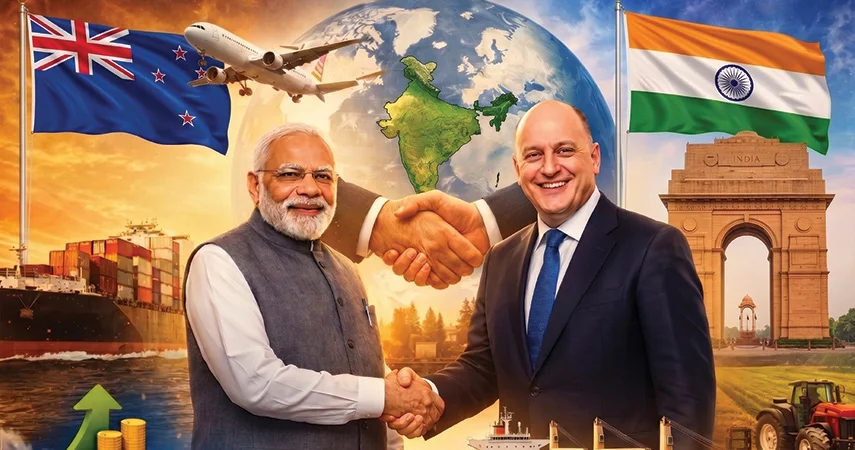
NEW DELHI: India and New Zealand signed a long-awaited free trade agreement (FTA) on April 27, sealing what New Zealand Prime Minister Christopher Luxon has described as a “once-in-a-generation” pact that opens new pathways for trade in goods and services, investment flows, and labour mobility between the two countries, according to a report in The Economic Times.
The pact was formalised in the presence of Commerce and Industry Minister Piyush Goyal and his New Zealand counterpart, Todd McClay. Welcoming McClay to India ahead of the signing, Goyal had said the visit marked a “defining moment” in the partnership between the two countries.
“The fact that we are making businesses easier to set up and work in India, reducing compliance burden, ensuring simplicity in operations, creating a business climate that is trusting and inviting, will help you both grow and enjoy good profits in India,” Goyal said at the signing ceremony.
The minister invited businesses to invest in India as the country can serve as a corridor for expansion across the world, whether it’s Africa, Latin America, West Asia, the US or Europe. “This can become your gateway to the entire world,” he said.
The agreement marks the culmination of negotiations that began in 2010, stalled in 2015 after nine rounds, and were revived in March 2025 before concluding in December last year: making it one of India’s fastest-concluded FTAs.
It spans 20 chapters covering goods, services, rules of origin, customs facilitation, sanitary and phyto-sanitary measures, technical barriers to trade, dispute settlement, and legal provisions.
The agreement marks the culmination of negotiations that began in 2010, stalled in 2015 after nine rounds, and were revived in March 2025 before concluding in December last year: making it one of India’s fastest-concluded FTAs.
Goyal called on businesses to expand cooperation in areas of agriculture, food processing, manufacturing, digital technology, artificial intelligence, quantum computing and clean energy to leverage markets in the two countries and across the world.
India-New Zealand FTA marks a major milestone in India’s liberalised trade journey, opening new opportunities for trade, investment, and deeper economic cooperation. Bilateral trade trajectory between India and New Zealand is expected to reach USD 5 billion by 2030 with a greater participation from MSMEs and labour intensive exports.
He said the FTA reflects “trust, shared values, and a common vision” for sustainable economic growth and mutual prosperity, and aligns with India’s priorities of strengthening economic resilience and promoting inclusive growth.
The agreement is said to provide unprecedented duty-free access for Indian exports while safeguarding sensitive sectors. It is also expected to enhance market access and tariff preferences, and serve as a gateway for India to expand trade linkages with Oceania Pacific Island markets.
Duty-free access, services push at core
At its core, the FTA lowers trade barriers and expands market access on both sides. India has secured duty-free access for all its exports to New Zealand, including labour-intensive sectors such as textiles, leather, plastics, and engineering goods.
The agreement also delivers gains in services, a key pillar of India’s trade strategy. Commitments span IT, education, financial services, tourism, and construction, alongside a new temporary employment visa pathway that will allow up to 5,000 Indian professionals to work in New Zealand for up to three years.
It also opens opportunities for India to expand services exports in areas such as engineering, healthcare, and education, as well as niche segments like Ayush, yoga, hospitality and music.
In addition, the pact is expected to catalyse investment flows, with projections of up to $20 billion in foreign direct investment from New Zealand into India over the next 15 years.
For New Zealand, the agreement provides immediate duty-free access to over 54 per cent of its exports to India, including sheep meat, wool, coal, and forestry products. Tariffs on several other goods, such as seafood, iron, steel, and aluminium, will be reduced or phased out over time.
Sensitive sectors ring-fenced
Despite the broad liberalisation, both sides have moved cautiously on politically sensitive sectors. India has protected key agricultural products such as apples, kiwifruit, manuka honey, and dairy through tariff-rate quotas, minimum import prices, and safeguard mechanisms.
New Delhi has also excluded sectors like dairy, sugar, and certain metals altogether to shield domestic producers, particularly small-scale farmers. This approach reflects a calibrated trade strategy that balances market access with domestic sensitivities.
Speaking about the partnership in the field of agriculture, Goyal said, “I would love to see some manuka honey come to India, but also would like to see our kiwi farmers benefit from this partnership.”
The Indo-Pacific trade calculus
While bilateral trade between India and New Zealand stood at around $2.4 billion in 2024, the agreement is expected to deepen economic ties and strengthen India’s trade engagement in the Indo-Pacific region.
The pact comes as India looks to expand its footprint in smaller, high-value markets and diversify its trade partnerships.
New Zealand, in turn, gains improved access to one of the world’s fastest-growing major economies and a large consumer base, with the agreement expected to support exports across sectors including agriculture and high-value food products.