




Blitz India Business
NEW DELHI: Trade policy is usually written in tariff schedules. Occasionally it is written in nautical miles. India’s agricultural and food exports to West Asia are worth about $11.8 billion a year, and a growing share of that traffic is being routed deliberately through Omani ports that sit outside the Strait of Hormuz — a logistics decision taken to insulate a food trade from a chokepoint risk that no exporter can price.
The commercial backdrop is the India–UAE Comprehensive Economic Partnership Agreement, in force since 2022, under which bilateral trade has grown sharply and the two governments have set a revised long-term target of $200 billion. India’s fastest-growing export categories into the UAE are pearls, precious metals and jewellery, electrical machinery and equipment, mineral fuels and oils, and aircraft parts — a list that has shifted noticeably away from primary commodities and towards processed and engineered goods. Investment has followed the same path, with Emirati capital moving into Indian clean energy, logistics, fintech, healthcare and advanced technology, and Indian firms taking positions in Gulf infrastructure and food security ventures.
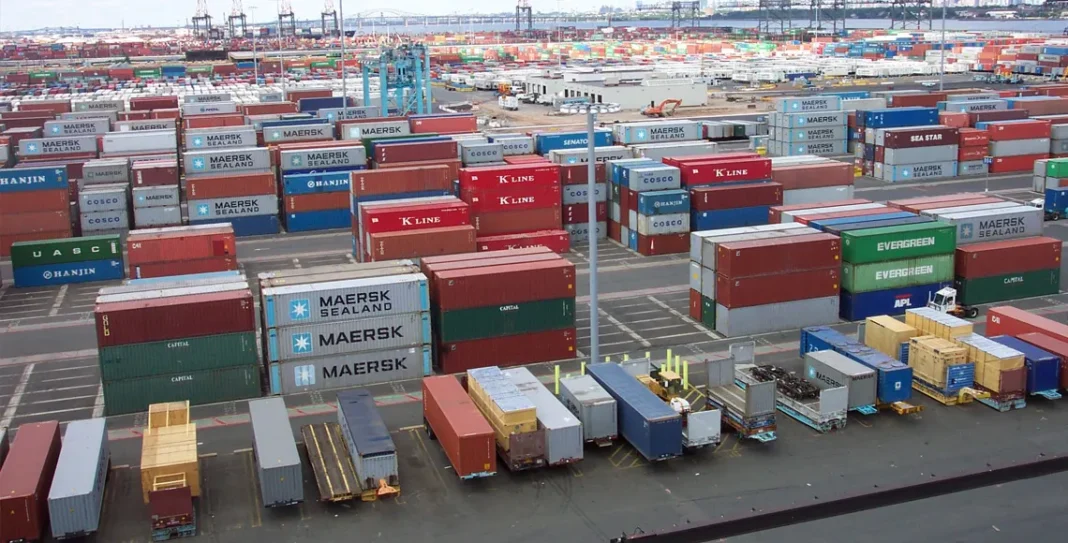
Geography as insurance: routing food cargo through ports outside the Strait of Hormuz costs freight days and buys continuity of supply.
A tariff cut raises the ceiling on a trade. A second route stops the floor falling out of it. The Gulf corridor now needs both.
At a Glance
• Agri and food exports to West Asia: about $11.8 billion a year
• Logistics shift: increasing use of Omani ports outside the Strait of Hormuz to reduce chokepoint exposure
• Framework: India–UAE CEPA, in force since 2022
• Target: a revised long-term bilateral trade goal of $200 billion
• Fastest-growing Indian exports to the UAE: pearls, precious metals and jewellery; electrical machinery and equipment; mineral fuels and oils; aircraft parts
• Investment flows: Gulf capital into Indian clean energy, logistics, fintech, healthcare and advanced technology
• Adjacent play: green hydrogen projects in Saudi Arabia and Oman, alongside India’s own five million tonne annual target by 2030
For an investor, the interesting question is who pays for the detour and who benefits from it. Routing outside Hormuz adds freight days and therefore cost, which compresses margins for exporters of low-value bulk agricultural produce and is largely absorbable for exporters of processed, higher-value food. That asymmetry quietly rewards precisely the shift Indian agri-export policy has been trying to encourage for a decade — from raw commodity to processed product — because a container of packaged, branded or value-added food can carry the extra logistics cost that a container of unprocessed bulk cannot. Port and cold-chain operators on India’s western coast, marine and dairy processors, and shipping lines with Omani transhipment relationships are the direct beneficiaries. The exposure sits with thin-margin bulk exporters who have not moved up the chain.
The corridor’s next leg is energy rather than food, and it is where the sums get larger. Green hydrogen projects under development in Saudi Arabia and Oman sit alongside India’s own target of five million tonnes of annual green hydrogen production by 2030, and the natural configuration — Gulf capital and land, Indian electrolyser manufacturing, engineering capacity and offtake demand — is one both sides have identified. The constructive framing for Indian industry is that the Gulf relationship is no longer principally about buying crude and selling rice. It is becoming a two-way industrial partnership in which India supplies capability as well as labour, and the remittance flows that have historically defined the corridor are being joined by equity, technology and long-term supply contracts. Building the redundancy into shipping routes now, before it is needed, is the least glamorous and most sensible part of that transition.