




Blitz India Business
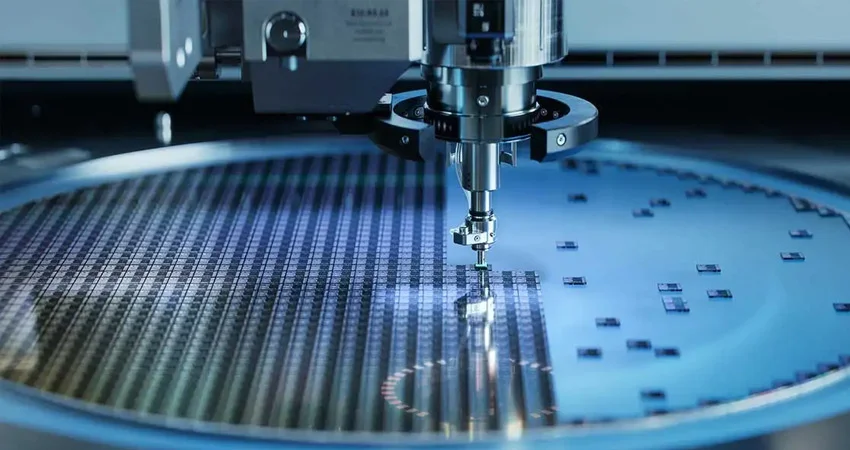
NEW DELHI: Industrial policy is easy to announce and slow to verify. Semiconductors have been India’s most-announced industrial ambition of the decade, and until recently the only honest thing to say about it was that construction had begun. That is no longer the only honest thing to say, and the sequence in which the pieces arrived is more instructive than any single milestone. The centrepiece remains the Tata Electronics–Powerchip fab at Dholera, for which a special economic zone was notified on April 9, 2026, and which targets first silicon by late 2026: 50,000 wafer starts a month at 28 nanometres, across 66 hectares, employing around 21,000 people.
The 28-nanometre choice is the part most often misread. It is not the leading edge — the most advanced logic is manufactured at a small fraction of that node — and it is regularly presented as evidence of modest ambition. It is closer to the opposite. Mature nodes at 28nm and above account for a very large share of global chip demand by unit volume: automotive controllers, industrial sensors, power management, display drivers, telecom infrastructure and the vast category of mainstream electronics that has no need of a three-nanometre transistor. It is also the segment where demand is durable, capital intensity is manageable and a new entrant can actually win qualification. A country building its first commercial fab at the leading edge would be making a much less defensible decision.
Packaging came first: assembly and test plants reached commercial production before the fab — the same order in which every successful semiconductor ecosystem has been built.
Every semiconductor ecosystem in history was built back to front — packaging first, fabrication later. India is following the only sequence that has ever worked.
At a Glance
• Tata–Powerchip fab, Dholera: SEZ notified April 9, 2026; first silicon targeted late 2026
• Scale: 50,000 wafer starts per month, 28nm node, 66 hectares, about 21,000 jobs
• Micron, Sanand: assembly, test and packaging facility inaugurated February 28, 2026 — the first operational facility of this mission cycle
• Kaynes Semicon, Sanand: OSAT unit reached commercial production in March 2026, 14 months after breaking ground
• First shipment: 900 multi-chip modules delivered to Alpha & Omega Semiconductor in October 2025
• Why 28nm: mature nodes serve automotive, industrial, power management, display and telecom — the largest slice of global demand by unit volume
The sequencing is the second lesson, and the more transferable one. India’s first operational plants were not fabs but packaging facilities: Micron’s assembly, test and packaging unit at Sanand, inaugurated on February 28, 2026, and Kaynes Semicon’s OSAT unit in the same district, which reached commercial production in March 2026 — fourteen months from groundbreaking, and having already shipped 900 multi-chip modules to Alpha & Omega Semiconductor in October 2025. Fourteen months from empty ground to qualified commercial output is a serious industrial result by any international benchmark. It is also the correct order of operations. Packaging plants train the technicians, establish the ultra-pure water and gas supply chains, prove that customs and logistics can handle wafer-grade materials, and teach an ecosystem what a semiconductor customer’s audit actually demands. Every country that now fabricates chips learned to package them first.
Which is why the honest assessment at this point is neither triumphal nor sceptical. India has demonstrated the second-hardest thing — that it can build and qualify assembly and test capacity fast — and is close to attempting the hardest, which is holding yield on a commercial fab. Yield, not capacity, is where fabs succeed or fail, and it is learned over quarters rather than announced. The constructive priorities from here are unspectacular: deepen the supplier base for chemicals, gases and photomasks so that the fab is not importing consumables at every ramp; hold the specialist engineering talent that the Sanand units have trained; and treat the late-2026 first-silicon target as a beginning rather than a finish line. On present evidence India will have a working 28nm fab. Whether it has a competitive one is a question the yield curve will answer in 2028.