




Blitz India Business
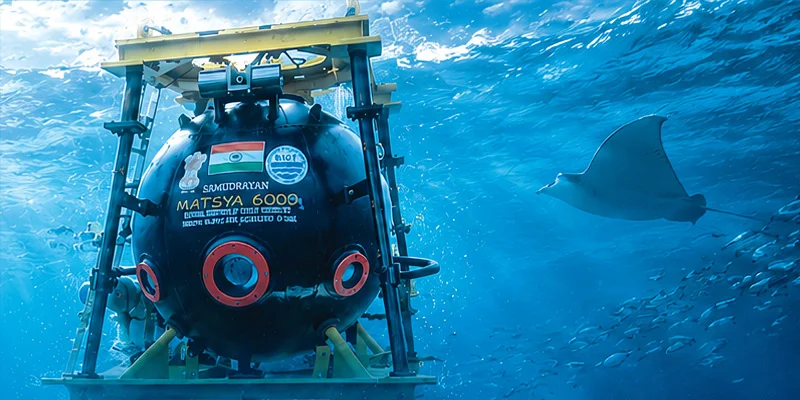
NEW DELHI: The Matsya 6000 (meaning ‘Fish 6000’) is India’s pioneering, indigenously designed crewed deep-submergence vehicle, developed as the centerpiece of the national Samudrayaan project under the Ministry of Earth Sciences’ broader Deep Ocean Mission.
The vehicle is engineered to carry a three-member crew down to a depth of 6,000 meters (nearly 20,000 feet) below the ocean surface.
Its crew compartment is a spherical pressure hull with a diameter of 2.1 meters and a wall thickness of 80 millimeters. It is forged from an advanced, high-grade titanium alloy chosen for its exceptional strength-to-weight ratio and resistance to harsh marine corrosion.
At 6,000 meters depth, the vehicle must withstand an external crushing pressure of approximately 600 bar (about 600 times standard atmospheric pressure) in frigid water conditions hovering around -3°C.
Under normal operating conditions, the submersible can execute 12 to 16 hours of underwater operations, with an emergency life-support endurance capacity of up to 96 hours. It features sophisticated atmospheric monitoring, lithium-ion power banks, acoustic communication systems, and automated buoyancy control.
Institutional synergy
Building the Matsya 6000 required cross-institutional synergy reminiscent of India’s space programme. These include NIOT (National Institute of Ocean Technology, Chennai) which led the overall design, integration, and marine testing. ISRO (Vikram Sarabhai Space Centre) contributed heavily to high-precision engineering, including executing high-penetration electron beam welding for the thick titanium sphere and advanced non-destructive testing.
Successfully deploying the Matsya 6000 will place India into an elite global club of nations – alongside the US, Russia, China, France, and Japan – capable of manned ultra-deep-sea exploration.
Its primary operational objectives include mapping and assessing deep-sea mineral reserves, specifically polymetallic nodules (rich in nickel, cobalt, copper, and manganese) and polymetallic sulphides within India’s allotted exploration zones in the Central Indian Ocean Basin, alongside bio-prospecting for unique deep-sea microorganisms.