




India’s two-table diplomacy
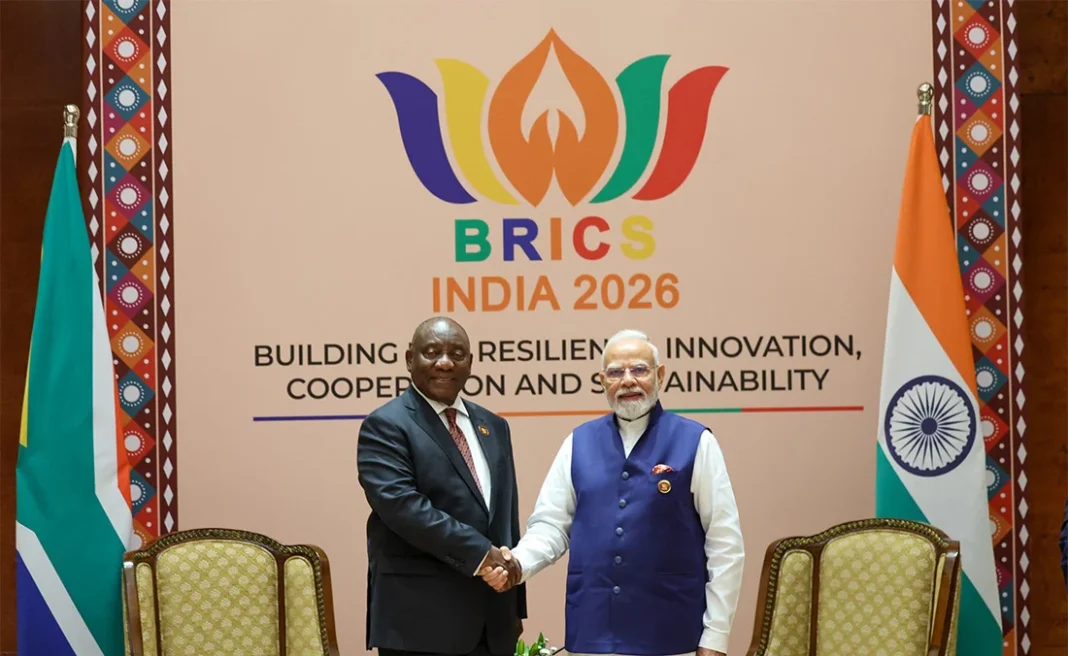
New Delhi, 14 September Within 24 hours of the 18th BRICS summit closing at Bharat Mandapam, India’s energy minister is in Houston for the G20’s energy ministerial. Two documents describe the two tables. Akashvani’s report of 14 September 2026 gives the summit its numbers: two days, 11 member countries, 10 partner countries, heads of international organisations, and 15 sit-down bilateral meetings by Prime Minister Narendra Modi in three days. The Ministry of Power’s press release gives the Houston agenda its shape: three pillars, three days, 14 to 16 September, and India’s position on each.
What the summit counted
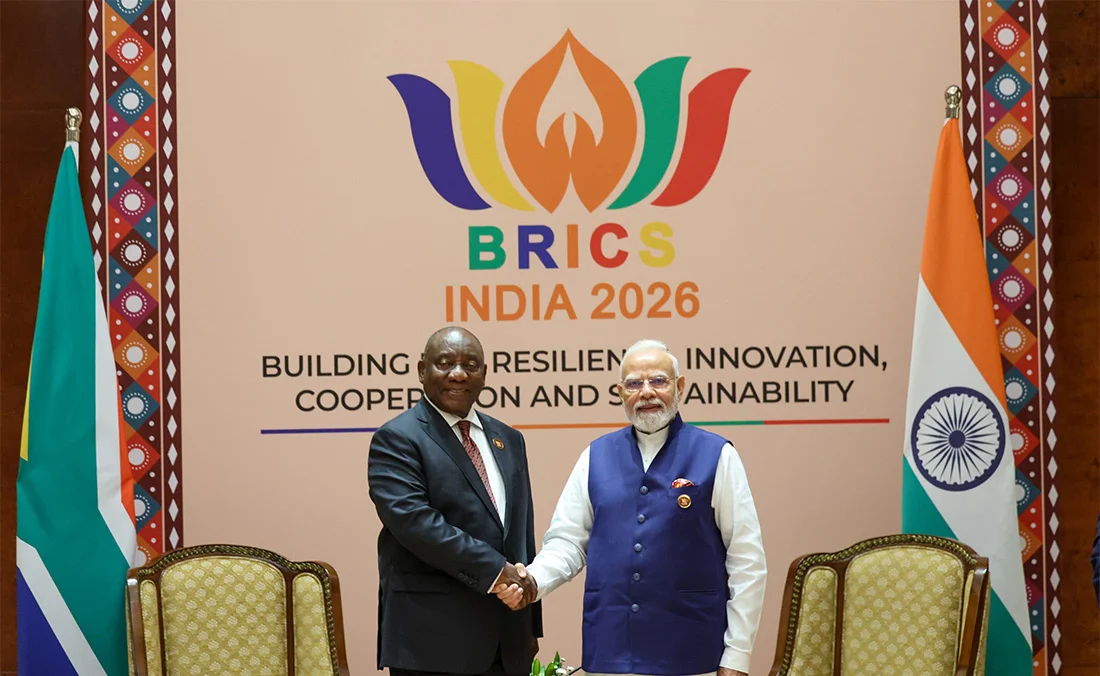
The Prime Minister’s video message of 14 September, thanking the BRICS leaders for a “productive and outcome-oriented” summit, closes the Delhi chapter. The business inside it was bilateral: fifteen meetings, five a day on the desk’s arithmetic, with, among others, Russia, China, Iran, the UAE, Malaysia, Vietnam, Indonesia, Egypt and the Philippines. A grouping whose members span the Gulf’s crude and gas, Russia’s fertiliser and Indonesia’s nickel is, for an importing economy, first of all a procurement conversation.
What Houston will discuss
The G20 table is about the same commodities from the other end. Under the American presidency the ministerial is built on “energy security and affordable baseload”, “permitting and regulatory efficiency” and “critical minerals and resilient supply chains”. The ministry says Union Minister Manohar Lal will argue for a system able to meet fast-growing demand, present India’s own permitting reforms as usable experience, and press diversification, circularity and “the entire value chain” of critical minerals, which means processing and recycling at home rather than buying refined material abroad.
The formulation India carries, “pragmatic, inclusive and technology-neutral”, and “respecting diverse national circumstances”, is the position of a country that will add generating capacity of every kind this decade and does not want the choice of fuel made for it in a communiqué.
The gain, in one line
Two rooms in one week where India’s purchase of energy and minerals, and its ambition to process them, are on the agenda with the sellers and the rule-writers present. That is the week’s return, and it is measurable only when the Houston outcome document and the BRICS bilateral follow-ups are published.
Blitz Data Card
At a glance: BRICS Delhi summit: 12–13 September 2026, 11 members, 10 partners, 15 bilateral meetings over three days · G20 Energy Ministerial, Houston: 14–16 September 2026, three pillars, India represented by the Union Minister of Power.’
What India gains
The buyer’s and the processor’s case for energy and minerals put in two forums in one week.
Indian women storm to Asia Cup glory
Dubai, 14 September India’s eighth women’s Asia Cup title came by 72 runs, as the final held on 13 September reduces the match to two rates: India 9.15 runs an over, Sri Lanka 5.55. India batted first for 183 for 5; Shafali Verma (68 off 39) and Smriti Mandhana (59 off 39) put on 129 for the first wicket in 77 balls, 70% of the total. Sri Lanka were 62 for 2 after 9.3 overs and all out for 111 in the twentieth, the last eight wickets going for 49.
Two spinners, seven wickets
The bowling was concentrated. Shree Charani’s four overs cost 20 and took four wickets, one over a maiden; Deepti Sharma’s four cost 19 and took three. Two bowlers, eight overs, seven of ten wickets, at 4.9 an over. Verma was named Player of the Match and of the Series; President Droupadi Murmu’s congratulations, reported by Akashvani on 14 September 2026, noted that India won every match of the tournament.
What India gains
For India, it is a title retained in the continent’s shortest format for the fourth time, and an all-women officiating panel, umpires Saleema Imtiaz and Shathira Jakir, television umpire Rokeya Sultana, reserve umpire Humaira Farah and referee Supriya Das, on the record of an Indian final.
Blitz Data Card
Dubai At a glance: India 183/5 (20 overs) · Sri Lanka 111 all out (20 overs) · Margin 72 · Opening stand 129 in 77 balls · Charani 4–20, Deepti 3–19.
What India gains
An eighth continental title and a spin pair proven in a final.
Dhiraj: From soldier to World Champion
Saltillo, 14 September Dhiraj Bommadevara’s 6–5 win over Japan’s Junya Nakanishi in the recurve men’s final at Saltillo, Mexico, recorded by World Archery on 13 September 2026. It makes him the first Indian man to win the Archery World Cup Final and the second Indian after Dola Banerjee in 2007. He came from 3–1 and 5–3 down, shot 29 and 28 to level, and took the shoot-off with a ten on the line.
The line about money
The sentence in his post-match remarks that a business reader should keep is the one about money. He dedicated the title to the Archery Association of India and the Government of India, “thanks to them, the financial struggles we faced have gradually eased”, and to his coaching staff, including coach Sonam Tshering Bhutia. The 25-year-old is a serving soldier, which puts the Indian Army among his employers and backers.
Antalya, then Saltillo
The road to Mexico ran through the Asian Championships title of 2025 and the Antalya World Cup stage gold of June 2026, which made him India’s sole qualifier for the eight-man final. Akashvani’s report of 14 September 2026 dates the previous Indian men’s recurve medal at this event to Jayanta Talukdar’s bronze in 2010. What India gains is a proven medal prospect for the 2028 Olympic cycle whose funding he has publicly credited.
Blitz Data Card
Saltillo
- At a glance Final 6–5 (shoot-off)
- Earlier rounds 7–1, 7–1
- Indian World Cup Final champions since 2006: two
- Last Indian men’s medal here: 2010.
What India gains
A men’s recurve champion two years before Los Angeles.
Hindi Diwas, banking and the business of language
Navi Mumbai, 14 September The sixth All India Official Language Conference opens in Navi Mumbai on 14 September, on Hindi Diwas, with Union Home Minister Amit Shah presenting the Rajbhasha Gaurav and Rajbhasha Kirti awards for 2025–26, according to Akashvani’s report of 14 September 2026. For a business reader the working part of the two-day event is the exhibition: stalls put up by banks, ministries, institutions and organisations showing how the official-language rules are met in the paperwork a customer actually sees.
The awards as a compliance score
The awards are the Department of Official Language’s annual measure of that compliance, given to offices and to individuals. The conference is organised by the department under the Ministry of Home Affairs; the fifth was held in Gandhinagar in 2025 and the fourth, in New Delhi in 2024, marked the diamond jubilee of the official-language framework. The 2026 edition builds its programme around Maharashtra’s ties to Hindi and a session on the national song, Vande Mataram.
A 52.83 crore market
The market the language serves is the reason banks are in the hall. The Census of 2011 counted 52.83 crore people with Hindi as their mother tongue out of 121.09 crore, 43.6% of the country on the desk’s arithmetic; Akashvani rounds it to more than 52 crore. A passbook, a loan agreement or an insurance form in the customer’s own language is compliance for the office and comprehension for the customer, and the second is what keeps the account open.
Blitz Data Card
Navi Mumbai At a glance Sixth All India Official Language Conference, two days, Navi Mumbai · Awards: Rajbhasha Gaurav, Rajbhasha Kirti, 2025–26 · Hindi mother-tongue speakers, Census 2011: 52.83 crore of 121.09 crore · Official language adopted: 14 September 1949.
What India gains
The official-language compliance of banks and ministries reviewed in public, in a non-Hindi state.