




Trade imbalance, named by both capitals
New Delhi, 13 September 2026For once the grievance is in both documents. The Indian readout of the Prime Minister’s meeting with President Xi Jinping on 12 September 2026 was issued by the Prime Minister’s Office through the Press Information Bureau at 7:45 pm. It says the two leaders “underlined the need to address each other’s concerns, including structural trade imbalance and supply chain issues, and facilitation of meaningful and predictable market access”. The Chinese Ministry of Foreign Affairs statement, posted at 11:44 pm Beijing time, says the two sides “should address each other’s economic and trade concerns in a balanced way”. Different words; the same item on the agenda.
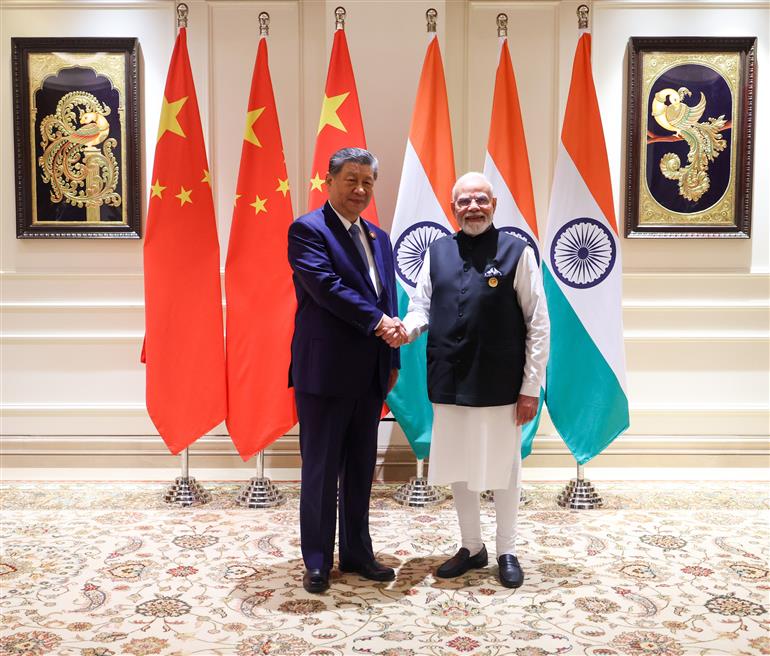
That is the business reader’s sentence. Trade takes 59 of the 266 words in the Indian text, 22% of it, recomputed here from the two texts — one paragraph in five, and the only one that names a problem rather than a principle. The Chinese text adds two things the Indian one leaves out: that bilateral trade “has hit a new high”, without a figure, and that direct flights and people-to-people exchange are the next step Beijing wants.
What was agreed, and what was not
Nothing on trade was signed. What was agreed is a description: an imbalance that is structural, supply chains that are an issue, and market access that should be meaningful and predictable. Each of those three words points at a file — the pharmaceutical and IT-services approvals Indian firms wait on in China, the components Indian electronics assembly imports from it, and the export licences that decide whether a shipment moves. The readout does not name the files. It names the categories, which is further than the two governments have gone in one paragraph before.
The boundary formula is the same in both texts — “fair, reasonable and mutually acceptable” — and both call the relationship strategic and long-term. The Chinese text carries four numbered observations from President Xi, including coordination in the United Nations, the Shanghai Cooperation Organisation and the G20 and support for each other’s BRICS chairship; China takes the chair in 2027. Several sentences attributed to the Prime Minister appear only in the Chinese text; this newspaper carries the Prime Minister’s words as his own office issued them.
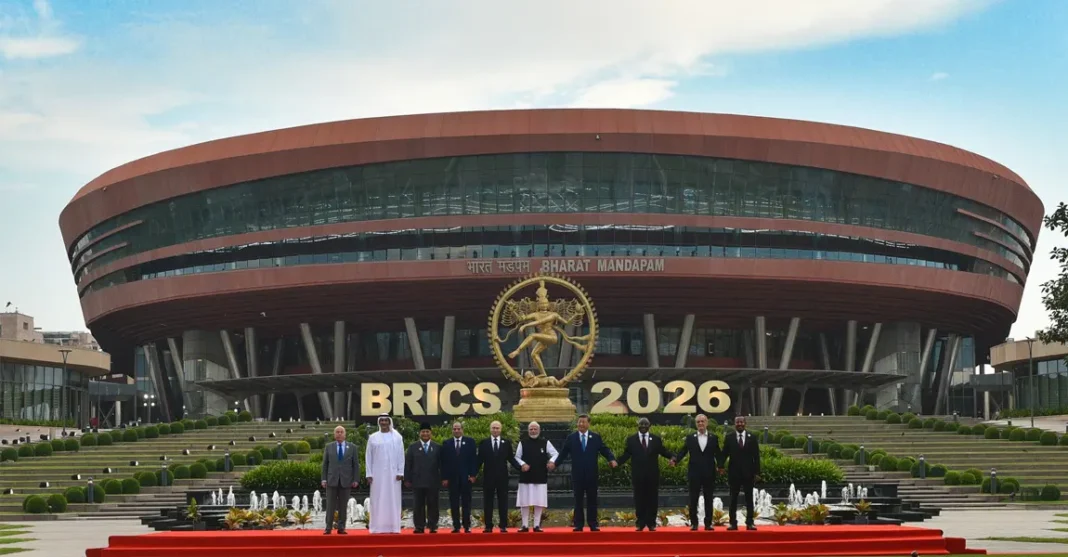
It was the third meeting in under two years — Kazan in October 2024, Tianjin on 31 August 2025, New Delhi 377 days later — and the first in which both readouts put the trade imbalance in the same sentence as market access. For an Indian exporter that is the gain: the deficit is now a stated agenda item on both sides, not a complaint from one.
Blitz Recommends
The Department of Commerce could publish, within the month, a one-page list of the market-access requests it has pending with Beijing by sector, so that “meaningful and predictable” has a checklist the next readout can be measured against.
BLITZ DATA CARD
What India gains: A structural trade deficit written into both governments’ record as an agenda item, with market access and supply chains beside it.
Blitz appreciates: The Ministry of External Affairs, for a readout that names the imbalance rather than the atmosphere, and the Prime Minister for the three mutuals.
₹13,589 crore settled in one day
New Delhi, 13 September 2026 ₹13,589.28 crore changed hands, or was agreed to, in a single sitting. That is the settlement value the National Legal Services Authority put on the 3rd National Lok Adalat of 12 September 2026 in its results card that evening — 2,10,39,112 cases disposed of in 26 States and seven Union Territories, figures as of 7 pm and provisional.
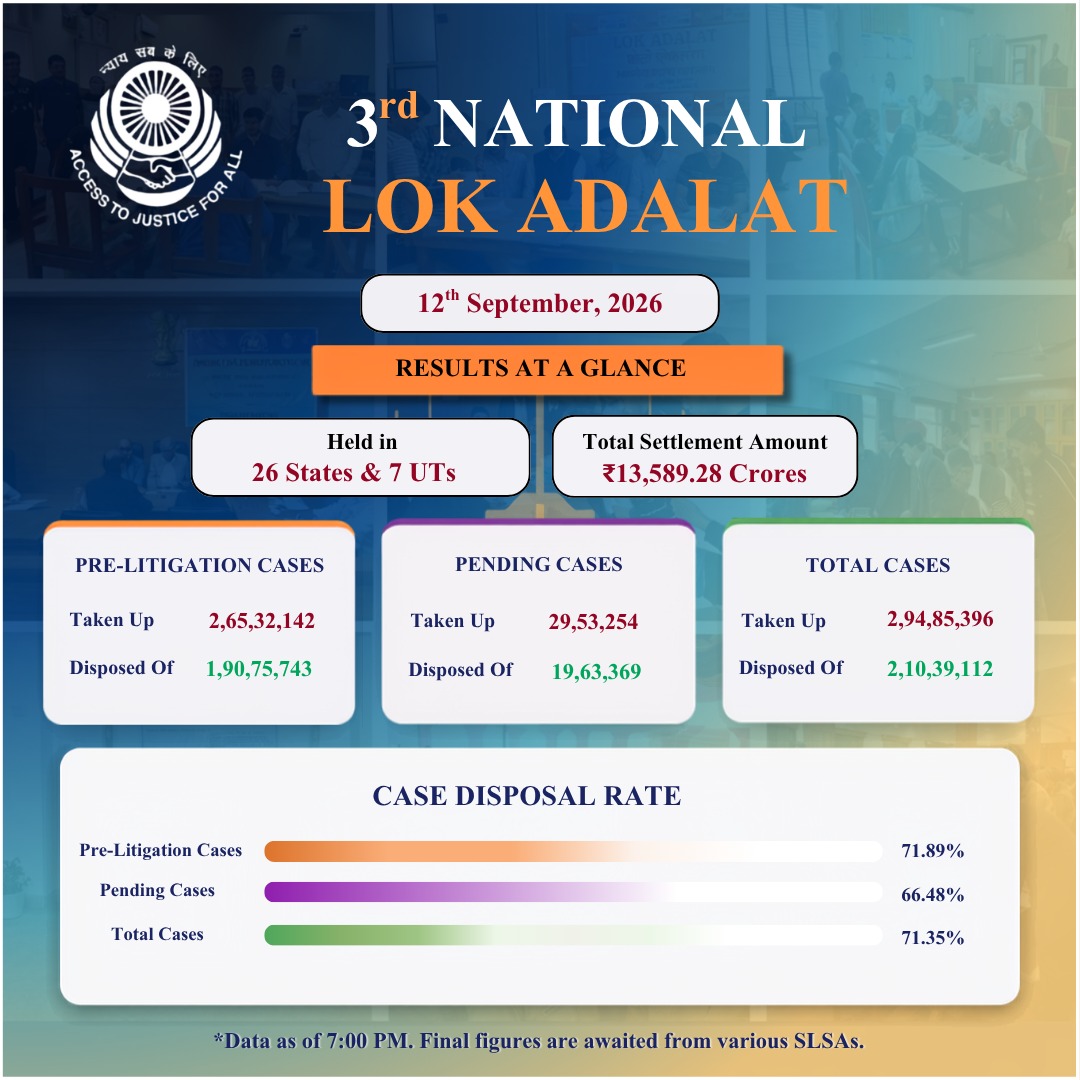
The money side of the day is mostly pre-litigation: 1,90,75,743 of the settled matters, 90.7% recomputed here, were brought to the bench before any suit — the bank recovery, the utility arrear, the bounced cheque that a lender would otherwise carry as a non-performing account for years. The average settlement works out at ₹6,459 a case, which is the scale of the ordinary household dispute, not the corporate one.
The clearance rate was 71.35% of the 2,94,85,396 cases taken up — 71.89% for pre-litigation matters and 66.48% for the 29,53,254 cases already pending in court. A Lok Adalat award is a decree under section 21 of the Legal Services Authorities Act, 1987, final and without appeal, with the court fee refunded, which is what makes it a recovery instrument for a bank and a closure for a borrower on the same afternoon.
Blitz Recommends
NALSA could break the ₹13,589 crore into its main heads — bank recovery, motor accident claims, cheque matters — so that lenders and insurers can see what the mechanism is clearing for them.
BLITZ DATA CARD
New Delhi, 13 September 2026 The record: 3rd National Lok Adalat, 12 Sep 2026 · settlement amount ₹13,589.28 crore · cases disposed of 2,10,39,112 (pre-litigation 1,90,75,743; pending 19,63,369) · taken up 2,94,85,396 · 26 States, 7 UTs · provisional, as of 7 pm.
Blitz calculation: Average settlement value: ₹13,589.28 crore ÷ 2,10,39,112 = ₹6,459 a case. Pre-litigation share of settlements: 90.67%. Overall disposal: 71.35%.
What India gains: ₹13,589 crore of disputes closed without appeal, most of it small-ticket credit and household matters that would otherwise sit on lenders’ books.
Blitz appreciates: NALSA under Chief Justice of India Surya Kant and Executive Chairman Vikram Nath, and the State Legal Services Authorities that sat the benches.
Primary source: National Legal Services Authority, 3rd National Lok Adalat — Results at a Glance, 12 September 2026, nalsa.gov.in · Verified on nalsa.gov.in, 13 September 2026, 10:20 IST.
₹1,271.80 crore for Andhra’s health build
New Delhi, 13 September 2026 The Centre’s five-year health-infrastructure sanction for Andhra Pradesh is ₹1,271.80 crore, across four components: critical care blocks, integrated public health laboratories, and urban and rural Ayushman Arogya Mandirs. The Ministry of Health and Family Welfare gave the figure in its release of 12 September 2026, as Union Health Minister Jagat Prakash Nadda opened ten critical care blocks and twelve laboratories in the State under PM-ABHIM.
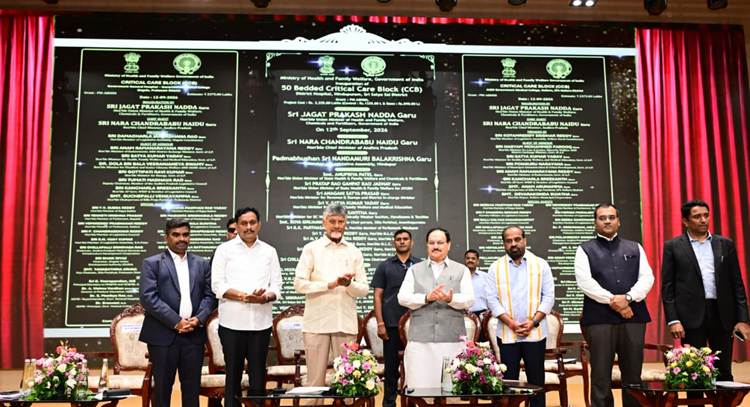
The two components opened this week are priced in the release: 24 blocks at about ₹606 crore, or ₹25.25 crore each by division, and 26 laboratories at ₹32.50 crore, or ₹1.25 crore each. Ten of the 24 blocks are now open — 41.7% — and all 26 laboratories are built and running. The release’s background note prices the same 50 facilities at ₹647.51 crore, ₹9.01 crore more than the two component figures add up to; the desk could not reconcile the two from the text.
Nationally the mission has sanctioned 631 critical care blocks, so the State’s 24 are 3.8% of the programme. The minister’s case for the spend was the pandemic ledger: wards converted to isolation, routine care stopped, and no laboratory network to see an outbreak coming. “Health security is national security,” he said, quoting the lesson of 2020.
Blitz Recommends
The ministry could publish the PM-ABHIM release schedule State by State against sanction, so that the ₹1,271.80 crore can be read as money spent, not money approved.
BLITZ DATA CARD
Blitz calculation: Per block ₹606 ÷ 24 = ₹25.25 crore · per laboratory ₹32.50 ÷ 26 = ₹1.25 crore · unreconciled gap ₹647.51 − ₹638.50 = ₹9.01 crore · CCB share of the two-component total 606 ÷ 638.5 × 100 = 94.9%.
What India gains: Public intensive-care capacity priced at ₹25 crore a block, a fraction of a private tertiary build, in ten district and college hospitals.
Blitz appreciates: Union Health Minister Jagat Prakash Nadda and the Andhra Pradesh health department, which finished every one of the 26 laboratories sanctioned.
Seven bilaterals, five of them African
New Delhi, 13 September 2026Of the seven bilateral meetings on the Prime Minister’s programme for 13 September 2026, five are with African governments: South Africa, Egypt, Burundi, Uganda and Nigeria. The other two are Kazakhstan and the Philippines. The schedule was reported by Akashvani’s 9:05 am bulletin, which counted the presidents of five nations, and by ANI at 9:32 am, which named the seven, including the vice-presidents of Uganda and Nigeria.
Set beside the first day’s four readouts from the Press Information Bureau — China, the Abu Dhabi Crown Prince, Vietnam and Malaysia — the summit’s two days give the Prime Minister eleven one-to-one meetings, on the desk’s count. The first day was East Asia and the Gulf; the second is Africa and Central Asia, the markets Indian pharmaceutical, two-wheeler and engineering exporters reach through distributors rather than through embassies.
The day’s plenary is the open session with the partner countries, titled “Resilience, Innovation, Cooperation and Sustainability: Shaping the Future for Inclusive Global Growth”, in the Summit Hall at Bharat Mandapam. It is the last session India chairs before the chair passes to China for 2027 under the New Delhi Declaration published by the Ministry of External Affairs on 12 September 2026.
Blitz Recommends
The Department of Commerce could pair each of the seven readouts, when issued, with the bilateral trade figure for that country from its own export-import data bank, so that the meetings can be read as markets and not only as courtesies.
BLITZ DATA CARD
The record: Bilateral meetings scheduled, 13 Sep 2026: 7 (South Africa, Egypt, Kazakhstan, Philippines, Burundi, Uganda, Nigeria) · bilateral readouts issued, 12 Sep 2026: 4 (China, Abu Dhabi, Vietnam, Malaysia) · open session with partner countries, Summit Hall, Bharat Mandapam.
What India gains: A day of head-of-government access to five African markets and two Asian ones, in Delhi, without a single overseas flight.
Blitz appreciates: The Ministry of External Affairs’ summit secretariat and protocol division, for eleven bilateral meetings inside a two-day summit.