




Coal India puts freight on fast track
NEW DELHI, 15 September A tonne of coal is worth what it is worth at the power station, not at the pit. Everything between the two is cost, and for most of Coal India’s history that cost was a truck.
The Ministry of Coal’s account of the company’s technology programme, published on 15 September 2026, puts hard numbers against the effort to change that. Of 92 planned First Mile Connectivity projects — coal handling plants, silos, conveyors and rapid loading systems — 46 are commissioned, creating about 432 MTPA of capacity. The programme is costed at about 27,800 crore rupees and targets 994 MTY of mechanical loading capacity by FY 2029-30.
The two halves do not match
Commissioned projects: 50.0% of the plan. Capacity created against the FY30 target: 43.5%. Both figures were derived here by dividing the ministry’s own numbers, and neither appears in the release.
The 6.5-point difference is the useful part. It says the second half of the programme carries, on average, slightly heavier projects than the first — 432 MTPA from 46 projects is about 9.39 MTPA each, and the remaining 46 must deliver about 562 MTY to reach 994. That is roughly 12.2 MTPA a project, a third more than the average commissioned so far.
Anyone modelling Coal India’s evacuation capex should hold that ratio. The back half of this programme is not a repeat of the front half.
Rail, and the other 23,465 crore
Four of seven critical railway projects are commissioned, together costed at about 23,465 crore rupees, with the remainder targeted by FY 2027-28. High-angle and sandwich conveyors are replacing heavy earth-moving machinery for in-pit transport. Taken with the first-mile programme, the company has about 51,265 crore rupees of evacuation infrastructure in play — a sum this desk arrived at by adding the two programme costs the ministry publishes separately.
Where the technology money goes
Exploration has changed the economics quietly. Non-invasive 2D and 3D seismic survey reduces boreholes by up to 50%, and machine-learning methods read banded coal seams off gamma-ray, density and resistivity logs. Coal India has an MoU with the National Remote Sensing Centre for a satellite dashboard covering mine monitoring and environmental auditing.
On the enterprise side the company runs SAP S/4HANA, e-Office and cloud infrastructure, with integrated command and control centres and a DigiCoal pilot across seven mines; 17 DigiCoal solutions tested in those seven are to be replicated across all mega mines.
Research spend is set at 1,900 crore rupees by FY30, across three Centres of Excellence — at IIT Hyderabad, IIT Madras and IIT-ISM Dhanbad — carrying 13 high-TRL and 11 low-TRL projects, 24 in all. Underground coal gasification at Kasta, indigenous perovskite solar cells with IIT Bombay and 500-tonne self-advancing goaf edge supports under trial at Churcha are the named projects.
Underground production is to rise to about 100 MT on continuous miner, longwall and highwall technology, with paste fill investment planned to release high-grade coal now locked in pillars. That last item is the one with the clearest balance-sheet consequence: coal in a pillar is a reserve that has been paid for and cannot be sold.
What India gains is a lower delivered cost of power and a mining workforce that spends less of its shift near a moving truck.
BLITZ DATA CARD
New Delhi : At a glance
First Mile Connectivity projects planned: 92
Commissioned: 46
Capacity created: about 432 MTPA
Programme cost: about 27,800 crore rupees
FY30 target: 994 MTY of mechanical loading capacity
Critical railway projects commissioned: 4 of 7, about 23,465 crore rupees
Research spend planned: 1,900 crore rupees by FY30
What India gains
Cheaper delivered coal, fewer loaded trucks on village roads, and a measurable capital plan that a power producer or a lender can model against.
India’s recycling market hits a new scale
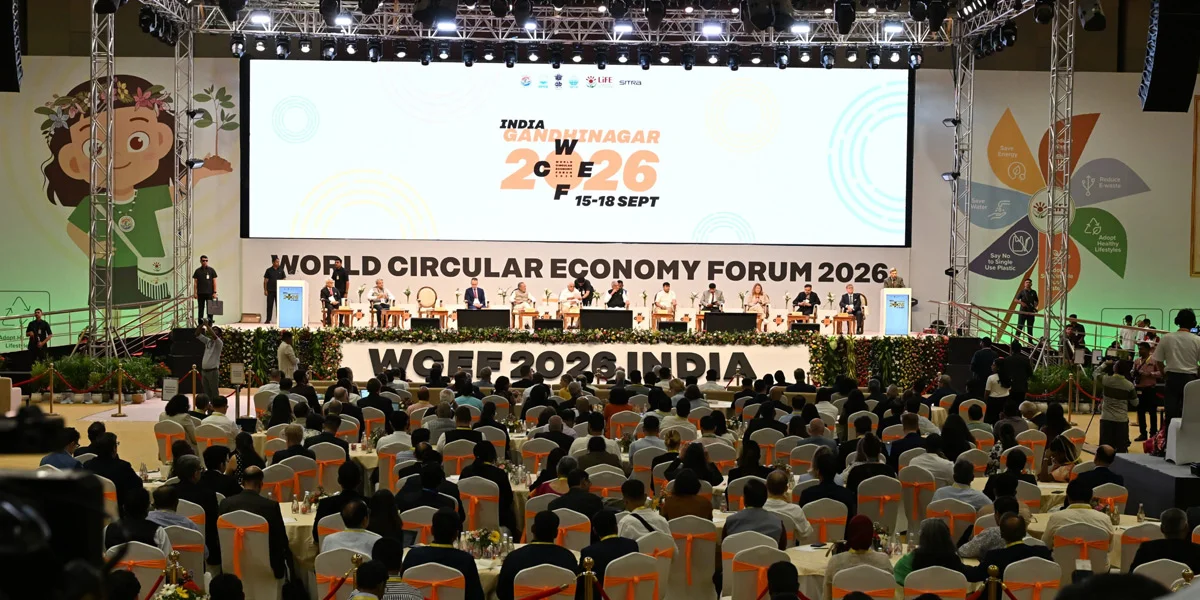
GANDHINAGAR, 15 September 2026The tenth World Circular Economy Forum opened at Gandhinagar on 15 September 2026, the first time it has been held in South Asia, and it runs to 18 September under the theme Circular Economy: Transition for People and Prosperity.
For a business reader the useful content of the inaugural session was one paragraph of the Environment Minister’s keynote. As of August 2026, Bhupender Yadav said, more than 83,000 producers and 4,802 recyclers stood registered under the various Extended Producer Responsibility frameworks, with nearly 482.24 lakh metric tonnes of waste processed across regulated waste streams.
That is 4.82 crore tonnes. Divide it by 4,802 registered recyclers and it comes to about 10,043 tonnes each; divide the producer count by the recycler count and it comes to 17.3 producers for every recycler. Both divisions were done here.
Extended Producer Responsibility works through a certificate market: the producer must show recycled tonnage, the recycler supplies the proof. A seventeen-to-one ratio between the two sides of that market is a statement about price. Where registered recycling capacity is thinner than the obligation it has to discharge, certificates are the scarce good — and the scarcity is not evenly spread across plastics, electronics, batteries and tyres.
The Minister also placed the subject inside two chairs India has held: the Resource Efficiency and Circular Economy Industry Coalition launched during the G20 Presidency, and India’s BRICS Chairship, which has put the circular economy alongside sustainable lifestyles, ecosystem restoration and adaptation.
Two publications were released at the session, one of them Driving Sustainability — A Guide to India’s Circular Economy and EPR Initiatives. The forum carries 135 exhibitors and more than 3,600 stakeholders from 62 countries; more than 100 Finnish companies and over 20 Dutch companies and organisations are working in or attending alongside the Indian market.
What Indian industry gains is early sight of the compliance vocabulary its export customers will use. Recycled-content rules travel across borders faster than recycled material does.
BLITZ DATA CARD
Gandhinagar : At a glance
Producers registered under EPR frameworks: more than 83,000, as of August 2026
Recyclers registered: 4,802, as of August 2026
Waste processed across regulated streams: 482.24 lakh metric tonnes
Countries represented at the forum: 62
Exhibitors: 135
How it compares
Producers on the rolls: 83,000 — the larger side, 100%
Recyclers on the rolls: 4,802 — 5.8% of the producers
Producers outnumber recyclers by about 17 to one.
What India gains
A compliance market whose shape is now public, and a place at the table where the recycled-content rules Indian exporters will have to satisfy are being drafted.
From gridlock to Gati Shakti in Varanasi
VARANASI, 15 September The Varuna Elevated Corridor was approved by the Union Cabinet in July at 10,998 crore rupees for 43.218 km. That is about 254.48 crore rupees a kilometre, on this desk’s own division — high, and consistent with elevated construction through a dense heritage city.
The Ministry of Road Transport and Highways release of 15 September 2026 itemises 4,565.33 crore rupees for civil construction and 934.91 crore rupees for land acquisition. Those two sum to 5,500.24 crore, or 50.01% of the sanctioned figure. The remaining 5,497.76 crore covers the rest of the project cost and is not broken up in the release.
The National Highways Authority of India will build a predominantly elevated 6/4-lane corridor connecting NH-31 with the Varanasi Ring Road, including a cable-stayed bridge and an extradosed foot over bridge-cum-major bridge, designed for 80–100 kmph.
The operating case rests on time saved. NH-31 to Kashi Railway Station is projected to fall from about 40 minutes to nearly 20; Varanasi Junction to Lal Bahadur Shastri International Airport from nearly an hour to around 20 minutes. Those are cuts of 50% and about 67%.
The freight argument is the one that will decide whether the corridor pays. Aligned with the PM Gati Shakti National Master Plan, it is to improve access to the Chandauli Socio-Economic Zone and six major logistics nodes, and to ease the movement of agricultural produce, industrial goods, construction materials and minerals between Varanasi, Chandauli and the adjoining region. India gains a freight corridor that does not have to cross a pilgrimage crowd to reach a railhead.
Pension goes door-to-door in rural India
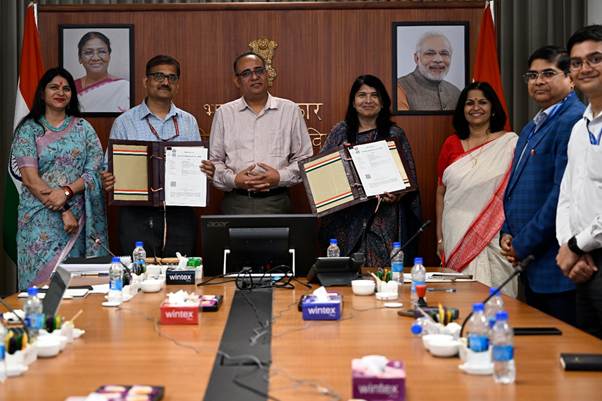
NEW DELHI, 15 September 2026The Department of Rural Development and the Pension Fund Regulatory and Development Authority signed a Memorandum of Understanding on 14 September 2026 to create a cadre of Pension Sakhis across rural India.
The commercial logic is distribution. Pension products fail in rural markets not on price but on reach: the cost of explaining a thirty-year product to a household with irregular income exceeds anything the product can pay a distributor. The MoU sidesteps that by using a cadre the Deendayal Antyodaya Yojana–National Rural Livelihoods Mission has already trained and already pays for — the Banking Correspondent Sakhis and other community resource persons.
The MoU was signed by Joint Secretary, Department of Rural Development, Amit Shukla and Executive Director, PFRDA, Sumeet Kaur Kapoor, in the presence of Secretary, Department of Rural Development, Rohit Kansal. Enrolment and outreach are to be tracked through digital dashboards and the Department’s LoKoS system.
Rohit Kansal said social security “is not only about protection against vulnerability; it is also about giving households the confidence and resilience to pursue sustained economic advancement”, and stressed that the work must rest on honesty, transparency and trust.
For the National Pension System the addressable market here is households already inside the formal banking system but outside any retirement product. India gains a second stage to financial inclusion — from an account opened to a liability provided for.
SARAL AI brings science out of the lab
NEW DELHI, 15 September The CSIR-National Institute of Science Communication and Policy Research is converting research published in its journals into short videos using SARAL AI, a tool of the Anusandhan National Research Foundation, according to the Ministry of Science and Technology release of 15 September 2026.
The institute ran a hands-on workshop with more than 90 participants, including journal editors and researchers, and is putting the videos out on a dedicated playlist.
Director, CSIR-NIScPR, Geetha Vani Rayasam said scientific knowledge “creates greater value when it reaches beyond the research community”. Chief Executive Officer, ANRF, Shivkumar Kalyanaraman said: “Research should not stop with publication.”
The economics are simple and rarely stated. The marginal cost of an additional reader for a journal paper is near zero, but the marginal cost of an additional comprehending reader is not — and that second cost is what has kept Indian journal output invisible to Indian industry. India gains when a process engineer finds in four minutes what a national laboratory solved last year.
No photograph
CAG puts Himachal’s public finances under the lens
SHIMLA, 15 September Report No. 1 of 2026 of the Comptroller and Auditor General of India — the Composite Audit Report for the period ended March 2023 on the Government of Himachal Pradesh — was tabled on 3 September 2026. The auditor’s own report page records that it was sent to the Government on 24 March 2026.
That is an interval of 163 days, about 5.4 months, computed here from the two dates the auditor publishes.
The report carries an information technology audit on e-procurement, a performance audit on the E-Way Bill System, a subject-specific compliance audit on the department’s oversight of Goods and Services Tax payments and returns filing for 2018-19 to 2020-21, and a review of the financial performance of State Public Sector Enterprises.
For a business reader the last strand is the one to watch. A State’s public sector enterprises are where its contingent liabilities sit, and a periodic review of their financial performance is the only public document that prices them. India gains from an audit whose recommendations are acted on, and this desk will carry the findings with the Government’s replies beside them once the tabled report has been read in full.
No photograph