




Blitz Bureau
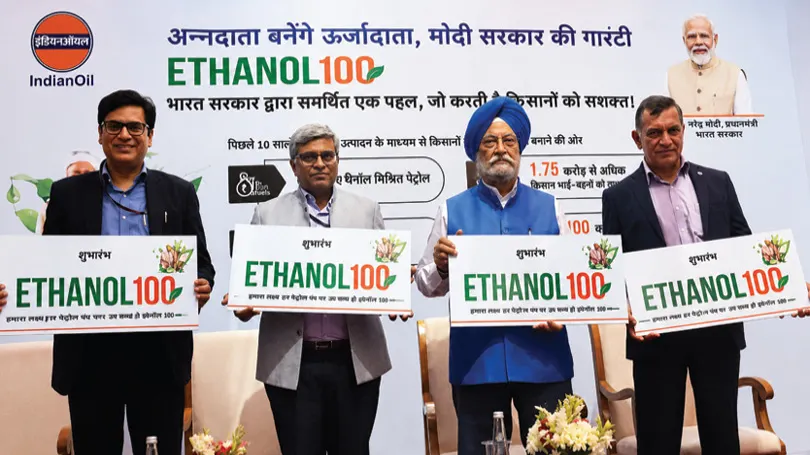
NEW DELHI: India has taken another significant step in its alternative-fuel journey, with Union Minister for Road Transport and Highways Nitin Gadkari announcing the approval of regulations that legally permit the use of E100 fuel in vehicles. An AutoPunditz analysis throws light on the ramifications of this move for cars, consumers and the ethanol economy.
Speaking at the Sugar, Ethanol & Bio-Energy India Conference in Nagpur, Gadkari said that he had signed the file finalising the regulatory framework for vehicles capable of operating on fuel containing nearly 100 per cent ethanol.
The decision clears an important legal and technical hurdle for automobile manufacturers planning to introduce flex-fuel and dedicated high-ethanol vehicles in India. It also signals that the Government’s ethanol strategy is moving beyond the nationwide E20 programme towards vehicles capable of operating on substantially higher ethanol concentrations.
However, regulatory approval alone will not result in the immediate nationwide availability of E100. Vehicle launches, fuel pricing, ethanol distribution, retail infrastructure and consumer acceptance will determine how quickly the technology moves from demonstration vehicles to mainstream adoption.
What is E100 fuel?
Despite its name, commercially used E100 is generally not laboratory-grade pure ethanol. Depending on the applicable fuel specification, it typically contains approximately 93-95 per cent anhydrous ethanol, with the balance comprising petrol and other additives.
These additives improve cold-start performance, fuel stability and handling. They can also make an ethanol flame more visible in the event of a fire, as pure ethanol can burn with a faint flame which is difficult to detect in daylight.
Pathway for flex-fuel vehicles
Flex-fuel vehicles are equipped with engines and fuel systems that can automatically adjust to different ratios of ethanol and petrol.
Unlike a conventional petrol vehicle calibrated for a specific fuel blend, a flex-fuel vehicle can detect the ethanol concentration in the tank and modify ignition timing, fuel injection and air-fuel parameters accordingly. This allows it to operate on fuels ranging from E20 to E85 or E100, depending on the vehicle’s certification.
India has already witnessed the unveiling of ethanol-compatible vehicles from manufacturers such as Maruti Suzuki and Hero MotoCorp. Maruti Suzuki recently showcased a flex-fuel WagonR, while Hero has demonstrated motorcycles designed for higher ethanol blends.
Gadkari has indicated that manufacturers including Toyota, Suzuki, Hyundai and MG are expected to introduce more ethanol-compatible vehicles. Several Indian manufacturers and component suppliers have also been developing fuel-system technologies capable of handling ethanol’s different chemical and combustion characteristics.
The new regulations provide automakers with greater clarity for vehicle testing, type approval, emissions compliance and commercial introduction.
Existing E20 cars cannot use E100
The approval of E100 does not mean that owners of conventional petrol or E20-compatible cars can start using the fuel.
Ethanol behaves differently from petrol and can affect fuel-system components that have not been designed for high ethanol concentrations. E100-compatible vehicles may require:
- Ethanol-resistant fuel lines, seals and gaskets: Formulated to prevent degradation, as ethanol dries out and cracks standard rubber.
- Corrosion-resistant fuel-system components: Upgraded tanks and lines to resist ethanol’s tendency to absorb water and corrode metals.
- Revised engine calibration & Modified engine-control software: Rewritten maps to dynamically adjust ignition timing based on the fuel mix.
- Different fuel-injection settings & Higher fuel-flow capacity: Required because ethanol requires a richer air-fuel mixture (roughly 30% more fuel volume) to produce equivalent power.
- Cold-start assistance: Necessary because ethanol does not vaporize easily at low temperatures, making cold mornings a challenge without a heater or a small petrol reserve.
- Ethanol-content sensors: Live sensors that detect the exact ratio of ethanol to petrol, allowing the ECU to adjust settings on the fly.
Using E100 in a vehicle that has not been certified for it could lead to starting problems, deterioration of rubber and plastic components, corrosion, drivability issues and possible engine damage.
Consumers will therefore need to follow the fuel-compatibility label specified by the vehicle manufacturer. An E20-compatible vehicle should not be assumed to be suitable for E85 or E100.
Fuel availability bigger challenge
The regulatory framework addresses the vehicle side of the equation, but India will also need a parallel expansion of ethanol dispensing infrastructure.
The Government has outlined an initial roadmap for flex-fuel-ready retail outlets in Delhi-NCR and the Mumbai-Pune-Nagpur corridors. The network is proposed to expand to around 500 outlets by December 2026 and approximately 5,000 outlets across major cities by the end of 2027.
This phased approach is essential because ethanol requires different storage, transport and dispensing arrangements from conventional petrol. Ethanol absorbs moisture more readily, which means fuel quality must be carefully controlled throughout the distribution chain. Fuel stations may require dedicated tanks, pumps, seals and handling procedures to prevent water contamination and material degradation.
Until a dependable retail network is established, E100 vehicles are likely to be introduced selectively in regions where suitable fuel is available.
Towards reducing dependence on imported oil
One of the principal arguments in favour of high-ethanol fuel is energy security.
The Government estimates that ethanol blending by public-sector oil marketing companies between Ethanol Supply Year 2014-15 and July 2025 resulted in foreign-exchange savings of more than ₹1.44 lakh crore. It also substituted approximately 245 lakh tonne of crude oil.
Moving from E20 towards E85 and E100 would potentially increase the amount of domestically produced fuel used in the transport sector. However, the overall benefit would depend on the scale of vehicle adoption, ethanol availability and the feedstock used to produce it.
Opportunity for agricultural economy
India produces ethanol from multiple feed stocks, including sugarcane molasses, sugar syrup, damaged food grains and maize.
Higher ethanol demand could provide an additional revenue stream for sugar mills, grain processors, distilleries and farmers. It could also help reduce sugar surpluses and provide new demand for maize and other suitable feed stocks.
At the launch of India’s first flex-fuel passenger vehicle, the petroleum ministry estimated that if 50 per cent of new two-wheelers and four-wheelers shifted to flex-fuel technology, it could create demand for an additional 311.8 crore litres of ethanol and generate ₹12,403 crore in additional income for farmers.
This explains why ethanol is being positioned not only as an automotive fuel but also as an agricultural and rural-development policy. Nevertheless, the ethanol programme will need careful feedstock planning. Expanding production should not create excessive pressure on food availability, groundwater resources or agricultural land.
The long-term sustainability of E100 will depend on increasing the share of ethanol produced from less water-intensive crops, agricultural residue, waste material and second-generation biofuel processes.
Environmental benefits
Ethanol combustion can reduce certain tailpipe pollutants, particularly particulate matter and carbon monoxide, compared with conventional petrol. Its high octane rating can also support more efficient engine designs.
The Government has cited life-cycle studies indicating that sugarcane-based ethanol produces around 65 per cent lower greenhouse-gas emissions than petrol, while maize-based ethanol can achieve an estimated reduction of around 50 per cent.
The Government’s ethanol strategy is moving beyond the nationwide E20 programme towards vehicles capable of operating on substantially higher ethanol concentrations.
However, calling ethanol completely emissions-free would be misleading. A vehicle burning ethanol still produces carbon dioxide at the exhaust. The environmental argument is based on the carbon absorbed by crops during their growth and on the possibility of producing ethanol from renewable biological material.
The actual life-cycle benefit varies depending on agricultural inputs, fertiliser use, irrigation, land-use changes, distillation energy, transportation and production efficiency.
Ethanol can therefore lower transport-related carbon emissions, but the extent of the reduction depends heavily on how it is produced.
E100 vehicles may consume more fuel
Ethanol contains less energy per litre than petrol. Consequently, a vehicle running on E100 generally needs to inject a larger volume of fuel to travel the same distance.
This means owners may experience lower kilometres per litre when using E100 than when using petrol.
The economic attractiveness of E100 will therefore depend not simply on its pump price but on its cost per kilometre. For example, even when ethanol fuel is cheaper per litre, the saving to the motorist may be reduced by higher volumetric fuel consumption.
Automakers can partially address this through engines designed to take advantage of ethanol’s high octane rating, higher compression ratios and optimised combustion.
A purpose-built ethanol engine may therefore deliver better efficiency than a basic flex-fuel conversion, although it would provide less flexibility when ethanol is unavailable.
Pricing will be key
India’s E100 transition is unlikely to gain scale unless the fuel is priced attractively relative to petrol.
The Government has already started creating fiscal support for higher ethanol blends. Petrol containing between 22 per cent and 30 per cent ethanol has recently been exempted from central excise duty, indicating an effort to encourage fuels beyond E20.
Similar pricing support, tax treatment or state-level road-tax concessions could become important for flex-fuel vehicles and E85/E100 fuels. Without a meaningful running-cost advantage, consumers may continue choosing conventional petrol, CNG, hybrid or electric vehicles.
India’s multi-fuel strategy
India is not pursuing a single replacement for petrol and diesel. Instead, its transport strategy is developing around multiple technologies:
- Battery-electric vehicles for urban mobility and selected passenger segments
- CNG and bio-CNG for private, commercial and public transport
- Strong hybrids for improving fuel efficiency
- Hydrogen for selected heavy-duty and long-distance applications
- Ethanol and flex-fuel vehicles for reducing petrol consumption
- Sustainable biofuels for aviation and other difficult-to-electrify sectors
E100 is therefore unlikely to replace electric vehicles or CNG. It will function as another option within a diversified energy strategy. Its strongest potential may lie in two-wheelers, small cars, commercial fleets and agricultural regions where ethanol production and distribution can be localised.
Impact on insurance
While ethanol blending has several benefits, it can have disastrous effect on cars which are not meant to run on this mixed fuel. So much so that insurance companies may refuse to bear the cost of damage incurred due to usage of ethanol-blended fuel.
The concern was recently trending on X following a post by ICICI Lombard that says that claims linked to E20-related damage in older, non-compatible vehicles could be rejected if insurers view the use of the fuel as negligence or improper use.
According to an ICICI Lombard blog published on June 9, 2026, insurance coverage generally remains unaffected if an E20-compatible vehicle is being used with E20 fuel.
However, the situation may be different for older vehicles that were not designed to run on the higher ethanol blend.
Ethanol burns cleaner than conventional petrol, helping reduce emissions. However, it behaves differently inside an engine and contains less energy per litre than petrol, which can result in a slight drop in fuel efficiency.
According to the ICICI Lombard blog, the bigger concern is the long-term impact on vehicle components. Ethanol can be corrosive and may gradually damage parts that were not designed to handle higher ethanol concentrations.
The report noted that vehicles manufactured after April 2023 under BS6 Phase 2 emission norms are designed to operate on E20 fuel without significant issues. For these vehicles, the impact of E20 fuel is expected to remain within acceptable limits.
Experts recommend that owners of older vehicles verify whether their car is E20-compatible before regularly using the fuel. Those unsure about compatibility should consult the vehicle manufacturer.