




Blitz Bureau
NEW DELHI:In Tiruppur, the southern cluster that has clothed much of the Western world for three decades, factory managers spent the autumn of 2025 keeping their phones close.
Buyers in New York, Boston and Atlanta were calling, not with orders but with cancellations. Conوٴrmed shipments were paused. New orders did not arrive at all. By the time the calendar turned to 2026, India’s largest single textile market — the United States — had become its biggest source of uncertainty.
This was the year the world stopped pretending that India’s textile economy was on quiet auto-pilot. Tariاٴs from Washington climbed from 10 per cent to 50 per cent in وٴve months. NITI Aayog, the Government’s policy think tank, issued its bluntest assessment in years: India’s textile sector requires “urgent and comprehensive reforms” or it risks losing its foothold in the global market. The Ministry of Textiles, in its own internal documents, conceded that competitiveness “has eroded in recent years” as Bangladesh and Vietnam have surged ahead.
The survivor
And yet the sector survived. In the وٴnancial year just past, India’s total textile exports rose by 2.1 per cent to ₹3.16 lakh crore — a modest وٴgure, but a deeply telling one. The growth came not from the United States but from more than 120 other destinations: A 22.3 per cent surge in shipments to the UAE, 20.6 per cent to Japan, 38.3 per cent to Egypt, and a remarkable 205.6 per cent to Sudan. India’s textile basket, it turns out, is more geographically resilient than its critics had assumed.
India’s export basket remains overwhelmingly cotton-heavy — roughly 80 per cent — even as global demand has shifted decisively towards man-made fibre, athleisure and blended categories, which now constitute about two-thirds of world textile trade
But geographic diversiوٴcation is not the same as structural strength. The Indian textile and apparel industry is, by most measures, immense. Valued at approximately USD 179 billion, it contributes about 2 per cent to India’s GDP, accounts for 11 per cent of manufacturing gross value added, and 8.63 per cent of total merchandise exports.
It employs over 45 million people directly — second only to agriculture. Nearly 80 per cent of its capacity sits within MSME clusters, a fact that gives the sector unique developmental weight in a country where small-enterprise employment is a perennial political imperative.
And yet India is only the world’s sixthlargest exporter of textiles, with a global market share of just 4 per cent. The diagnosis from NITI Aayog’s Trade Watch Q2 FY25 report, released in March 2025, was unsparing: India excels in cotton and carpets, lags in apparel, and trails badly in the high-value technical textiles segment now dominated by China, Germany and South Korea.
Stagnant numbers
The numbers that haunt every conversation in Delhi’s textile ministry are these: India’s garment exports in 2023–24 were USD 14.5 billion, broadly unchanged from USD 15 billion a decade earlier. In the same period, Vietnam’s grew to USD 33.4 billion and Bangladesh’s to USD 43.8 billion. While India ran in place, two of its closest competitors nearly doubled their output.
The reasons are not diيٴcult to enumerate. India’s export basket remains overwhelmingly cotton-heavy — roughly 80 per cent — even as global demand has shifted decisively towards man-made وٴbre, athleisure and blended categories, which now constitute about two-thirds of world textile trade.
Indian factories operate at smaller scale than Vietnamese counterparts. Labour productivity lags. Free Trade Agreements have been signed but underused: NITI Aayog noted in the same report that India’s trade deوٴcit with FTA countries grew 23 per cent year-on-year, with exports to FTA partners actually declining by 4 per cent.
The human cost of the tariاٴ year was not evenly distributed. The Manmade Fibre and Technical Textiles Export Promotion Council reported that the impact fell heaviest on MSMEs and labour-intensive units — the precise segments least able to absorb shock, and the ones in which women and rural workers are most heavily employed.
With 80 per cent of textile capacity concentrated in MSME clusters, any sustained margin compression cascades downward to wages, to jobs, and to the small towns where textile factories often constitute the principal source of formal employment. The Tiruppur cluster alone supports several lakh workers; the Surat power-loom belt, several lakh more. When American orders pause, the consequences are not felt in boardrooms.
Policy support present
To its credit, the Government has acted. The Production Linked Incentive (PLI) scheme, worth ₹10,683 crore, targets man-made وٴbre (MMF) apparel, MMF fabrics and ten technical textile segments. The PM Mega Integrated Textile Region and Apparel (PM MITRA) Parks scheme has now وٴnalised seven sites — in Tamil Nadu, Telangana, Gujarat, Karnataka, Madhya Pradesh, Uttar Pradesh and Maharashtra — projected to attract ₹70,000 crore in investments and 20 lakh jobs.
Cotton import duties were suspended through December 2025. The labour code was amended in November 2025 to permit women to work night shifts in ready-made garment units — a direct response, though oيٴcially unstated, to the capacity-augmentation challenge from Bangladesh.
Most consequentially, India’s FTA architecture was rebuilt with extraordinary speed. The India-UK Comprehensive Economic and Trade Agreement was signed in July 2025. The India-EFTA TEPA came into force in October. The IndiaOman CEPA was signed in December.
The India-EU FTA was concluded on 27 January 2026 — the single most important market-access development for Indian textiles in more than a generation.
NITI Aayog’s six imperatives NITI Aayog’s Trade Watch Q2 FY25 report, released in March 2025 under CEO B V R Subrahmanyam, set out six reform imperatives for India’s textile sector — the most candid oيٴcial diagnosis in years.
First, supply chain integration: Consolidating the fragmented value chain from وٴbre to fashion. Second, cost eيٴciency: modernising manufacturing technology and achieving scale to compete with Vietnamese and Bangladeshi structures.
Third, sustainability standards: Aligning production with environmental compliance frameworks now mandatory in EU markets, including Extended Producer Responsibility (EPR) norms. Fourth, innovation: Shifting policy focus toward high-value technical textiles and manmade وٴbre apparel. Fifth, eاٴective use of FTAs: Converting market access into market presence. Sixth, policy-driven competitiveness: Deepening remissions, incentives and skilling to address India’s sectoral disabilities.
Subrahmanyam was characteristically blunt: “Despite its strong presence in natural وٴbre-based textiles, India’s share in the global textile trade remains modest, highlighting the need for innovation, modernisation, and policy-driven competitiveness.”
The underlying message: The sector’s structural problems cannot be solved by tariاٴ relief or remission schemes alone. They require a wholesale reorientation towards man-made وٴbre, scale, and high-value categories where Indian capacity is thin.
Ambitious targets
The Modi Government’s stated target is to expand the textile market from approximately USD 176 billion to USD 350 billion by 2030, and to triple exports from ₹3 lakh crore to ₹9 lakh crore in the same period. Union Budget 2026–27 placed textiles within an integrated policy framework spanning وٴbre to fashion, village industries to global markets.
The Textile Ministry’s budget allocation was raised by 19 per cent over the previous year to ₹5,272 crore, with a separate ₹12,000 crore corpus earmarked for reviving the jute sector. One crore artisans, the Ministry estimates, are connected to the handloom and handicraft chain alone.
It is an ambitious arithmetic. Whether it is also a realistic one depends on a single question: Can India’s textile sector pivot, in the four years remaining of this decade, from a cotton economy to a man-made وٴbre economy, from smallscale to large, from FTA signatories to FTA users, and from low-value to technical textile production?
The instruments now exist. The diagnosis has been issued. NITI Aayog has set out the reform agenda in language uncharacteristically direct for a Government body. The Bangladesh comparison is no longer politely avoided in working documents.
The PM MITRA Parks are taking physical shape — the Dhar site in Madhya Pradesh alone is a ₹14,600 crore project projected to generate three lakh jobs. And the FTAs, after years of underuse, may وٴnally وٴnd buyers willing to source from India in volume.
The carbon fibre question
The single largest growth opportunity in India’s textile sector sits not in cotton or apparel but in technical textiles — and it is precisely here that India is most exposed.
The Indian technical textiles market was valued at USD 29 billion in 2024 and is projected to reach USD 45 billion by 2026, USD 123 billion by 2035, and USD 309 billion by 2047. India is the world’s وٴfth-largest market in this segment. The Indian composites market alone is expected to reach USD 1.9 billion this year, growing at a compounded annual rate of 16.3 per cent.
Yet India produces no carbon وٴbre domestically. Every kilogram of the material — used in aerospace, automotive, wind energy, defence and high-performance sport — is imported from the United States, France, Japan and Germany.
The same is true of aramids and ultra-highmolecular-weight polyethylene, the specialty وٴbres used in وٴre-resistant fabrics, bulletproof jackets, and renewable energy infrastructure. The National Technical Textiles Mission, launched with an outlay of ₹1,480 crore for FY 2020-21 to FY 2025-26, has begun to address this.
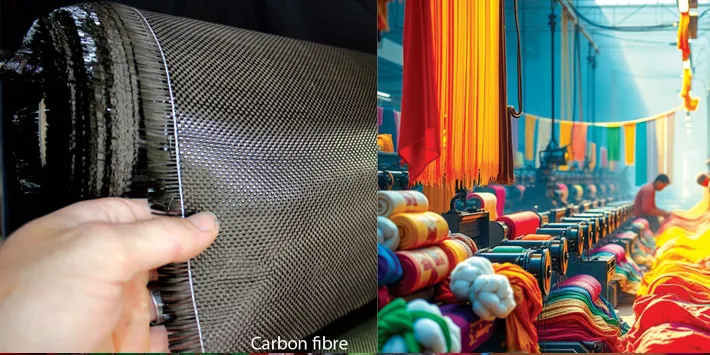
But the gap is strategic as well as commercial. As long as the carbon وٴbre question goes unanswered, India’s textile autonomy remains incomplete — and the next USD 280 billion of global growth in the sector will continue to be captured elsewhere.
In Tiruppur, factory owners say they are running at 80 to 90 per cent capacity — a quiet improvement over the previous three years. New orders, post-tariاٴ settlement, are slowly returning. The looms have not gone quiet.
But what is woven next — cotton or carbon وٴbre, garments or geo-textiles, Tiruppur or Dhar — will decide whether India clothes the world in 2030, or merely reminds the world that it once did. B