




Blitz Bureau
NEW DELHI:On a sweltering June afternoon in Jaipur, a woman switches on her new inverter air conditioner for the first time. She has saved for 18 months to buy it. Four thousand kilometres away, in a suburb of Seoul, an engineer reviews algorithms teaching a refrigerator to order milk before the household runs out. And somewhere between these two moments, between aspiration and automation, between the first purchase and the last disposal, lies one of the most consequential industries on the planet.
White goods: refrigerators, washing machines, air conditioners, dishwashers, freezers, ovens. The term is unglamorous by design. Yet these silent, humming, enamel-finished objects are now the centrepiece of a market valued at approximately $804 billion, on course to surpass $1 trillion by 2030, and $1.87 trillion by 2035.
Globally, only 17.4 per cent of electronic waste is recycled in an environmentally sound manner. The remainder — worth an estimated $57 billion in recoverable raw materials including iron, copper, and gold — is dumped, burned, or exported to communities ill-equipped to handle it safely.
They are the infrastructure of modern domestic life, and their story in the year 2026 is one of breath-taking ambition, ferocious competition, and a gathering environmental reckoning that the world can no longer afford to ignore.
A market without ceiling
The numbers are striking in their consistency. Multiple forecasters place the global white goods market’s compound annual growth rate between 7.8 per cent and 8.4 per cent through to 2035, a pace that would make this sector the envy of most industries.
Growth in the historic period has been driven by household appliance adoption, the expanding penetration of air conditioners, and the relentless rise of the commercial kitchen. The forces shaping the decade ahead are more sophisticated: smart connected appliances, energy-efficient cooling and heating systems, and the explosive expansion of e-commerce as a distribution channel.
North America remains the largest single region, but Asia-Pacific is the story. China holds 30.8 per cent of the regional market. India, at 15 per cent, is the most dynamic frontier, a $13 billion market in 2024, projected to reach $20 billion by 2032. In India, air conditioners are surging on the back of rising temperatures, expanding urban housing, and the proliferation of EMI-based purchase schemes that have placed ownership within reach of the emerging middle class.
Air conditioners, refrigerators, and washing machines together account for over three-quarters of India’s white goods demand. The European market, disciplined by stringent regulation, favours energy-conscious premium models, with Eastern Europe representing the next growth frontier.
India: The great white goods awakening
India is not merely a participant in the global white goods boom — it is one of its defining chapters with the market growing at a compound annual growth rate (CAGR) of 5.5 per cent. The air conditioner segment is the headline act, propelled by a combination of rising summer temperatures, urban densification, and a Government star-rating awareness programme that is quietly nudging consumers toward energy-efficient inverter models.
Yet the opportunity carries its contradictions. India’s e-waste burden is already among the world’s heaviest: Mumbai generates 1.2 million tonne of discarded electronics annually; Delhi produces 0.98 million tonne; Bangalore, 0.92 million tonne.
As millions of first-time white goods buyers enter the market, the question of what happens to these appliances at end-of-life is one that neither manufacturers nor policymakers have answered with sufficient urgency. The boom in new purchases risks becoming a slow-motion environmental crisis unless recycling infrastructure is built at comparable speed to the aspirations of the consumers it must eventually serve.
The intelligence revolution
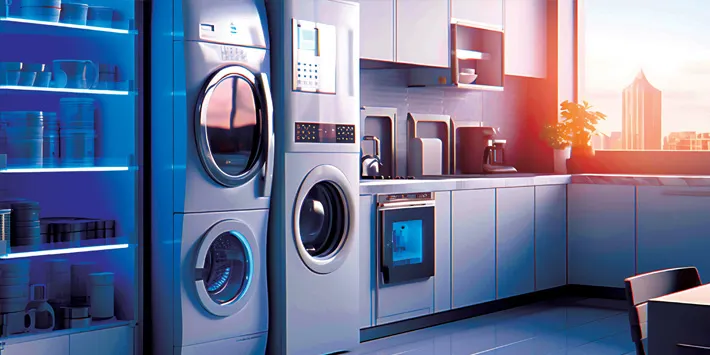
The white goods of 2026 are not the appliances of 2010. Over 66 per cent of newly launched products feature built-in Wi-Fi connectivity. Nearly half of all new product sales are smart or connected appliances. The defining trend of this moment is the integration of Generative AI and matter-standard connectivity, a new protocol allowing appliances from competing brands to communicate seamlessly, creating unified home ecosystems that learn household rhythms and adapt to them. A refrigerator no longer merely preserves food; it monitors inventory, tracks expiry dates, suggests recipes to reduce waste, and in the most advanced iterations, places orders without being asked.
The energy dividend is not trivial. McKinsey research found that AI-enabled appliances can reduce yearly household energy expenditure by up to 30 per cent. The US Department of Energy reports that efficient appliance models cut household electricity consumption by 28 per cent.
Over 72 per cent of global consumers now prefer low-power-consumption products, and manufacturers are responding: 72 per cent of new white goods are being designed with eco-friendly materials, and 64 per cent of manufacturers are embedding AI and IoT capabilities into standard product lines. This is no longer a premium segment — it is becoming the default.
The corporate battlefield
Four companies, Whirlpool, Haier Group, LG Electronics, and Samsung, collectively command over 40 per cent of the global white goods market. Each holds its ground through different strategies. LG leads in dollar-share premium positioning in the United States, holding 20.9 per cent of the value market even as it faces modest unit-share pressure.
Whirlpool is clawing back volume, its unit share rising from 15.0 per cent to 15.5 per cent in a single quarter, signalling renewed momentum in value-oriented segments. Samsung advances steadily, its connected ecosystem integration giving it structural advantage as the smart home market matures.
The most consequential story in corporate white goods is Haier’s quiet, relentless ascent. Through a decade of strategic acquisitions, including GE Appliances in 2016 and, most recently, Electrolux South Africa in December 2024, the Chinese giant has built a genuinely global footprint. Meanwhile, a reported Bosch bid for Whirlpool, if realised, would trigger the industry’s most significant consolidation in a generation. Challenger brands, Midea, Hisense, Arcelik, are gaining ground through aggressive IoT adoption and competitive pricing, particularly in emerging markets where first-time buyers outnumber replacement-cycle purchasers.
Tariffs, steel, and costs
The industry that sells comfort is itself deeply uncomfortable. US tariffs on steel and aluminium, imposed in February 2025, have cascaded through manufacturing costs and are expected to reach the consumer in the form of higher appliance prices.
Supply chain bottlenecks — a residue of pandemic-era disruption compounded by geopolitical friction — have extended lead times by 15 to 20 per cent compared to pre-pandemic levels. Regulatory compliance now adds 8 to 10 per cent to production costs in markets subject to the EU’s demanding Ecodesign Directive.
A Thomson Reuters global trade report found that 72 per cent of trade professionals in 2026 identify US tariff volatility as the most impactful regulatory change of the year — double the figure recorded twelve months earlier.
Prosperity’s hidden cost
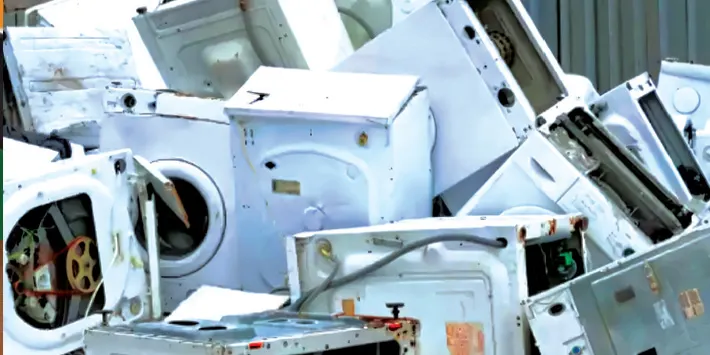
Every appliance sold eventually becomes waste. That is not a counsel of despair — it is a statement of physics. And the reckoning, when it comes, is now arriving. Globally, only 17.4 per cent of electronic waste is recycled in an environmentally sound manner. The remainder — worth an estimated $57 billion in recoverable raw materials including iron, copper, and gold — is dumped, burned, or exported to communities ill-equipped to handle it safely.
Lead, mercury, cadmium, and arsenic leach into soil and water. Workers in informal recycling operations absorb toxins that cause cancers, neurological damage, and shortened lives.
The circular economy — in which appliances are designed for disassembly, components are recovered, and materials re-enter production — offers a structural solution. The EU’s Ecodesign Directive has already mandated a 20 per cent energy-use reduction and is pushing manufacturers toward repairability and recyclability.
Some manufacturers are responding with subscription-based maintenance models, modular designs, and direct-to-consumer repair programmes. But the gap between ambition and infrastructure remains vast, particularly in Asia and Africa, where appliance consumption is growing fastest and recycling systems are least developed. The trillion-dollar machine produces extraordinary abundance. What it produces next will define its legacy.
The unstoppable machine
The white goods industry is not one story but several, running simultaneously at different speeds. It is the story of a Jaipur family’s first air conditioner and a Seoul engineer’s AI algorithm. It is the story of a Haier acquisition in South Africa and a Bosch executive studying Whirlpool’s balance sheet. It is the story of a tariff on steel that raises the price of a Mumbai household’s washing machine, and of an electronics dump in Ghana where children sort through circuit boards with bare hands.
What binds these narratives is the central paradox of the modern appliance industry: it has never been more innovative, more connected, or more consequential — and it has never faced a more complex set of demands. To grow at 7.9 per cent every year while reducing energy consumption. To serve a billion first-time buyers while designing for end-of-life. To compete ferociously on price while meeting the most stringent environmental standards in history.
The companies that navigate this paradox with intelligence — that understand that a washing machine is not merely a product but a promise, from the factory floor to the landfill — will define the industry’s next generation. Those that do not will be remembered as the ones who missed the most important instruction in the appliance manual: what to do when the cycle is complete.