




Kalpit A Mankikar
While visiting India in April, US Vice-President J D Vance pitched for better bilateral ties and a greater stake for New Delhi in America’s manufacturing economy. The visit has given a new fillip to bilateral trade negotiations and defence cooperation. Vance also proposed co-production of munitions, industry alliance for joint-autonomous systems, and development of maritime systems. He referred to the intention of ‘hostile powers’ to dominate the Indo-Pacific region, hinting at China.
Amid US President Donald Trump’s tariff onslaught against China, Commerce Minister Piyush Goyal has put the onus on Beijing for distorted labour models, hidden subsidies, and unfair trade practices. Goyal also contrasted China’s Belt and Road Initiative (BRI) with the India-Middle East Economic Corridor (IMEC), stating that the latter does not violate the sovereignty of nations and territorial integrity.
Manufacturing push and US courtship has Beijing worried
The IMEC blueprint envisages a network of road, rail, and maritime links from India, Saudi Arabia, Europe, and beyond, connecting Asia to the West. New Delhi’s stand on China’s BRI has been consistently in opposition, considering the China-Pakistan Economic Corridor (CPEC) runs through Pakistan-Occupied Kashmir (POK), which India claims belongs to an undivided Jammu and Kashmir.
Beijing sees these assertions as a convergence of Washington and New Delhi’s interests. This has spurred Chinese commentators to assess the evolving nature of India-US relations under Trump 2.0 and Modi 3.0 administrations.
Chinese commentators highlight Foreign Minister S Jaishankar’s front-row seating at Trump’s inauguration and Prime Minister Narendra Modi’s Washington visit in February as evidence of brewing bonhomie. Nonetheless, they also note the ‘irritants’ such as Trump calling out India over high tariffs shortly. Vance is derisively referred to as ‘India’s son-in-law’. Mandarin-language writing claims that America’s goodwill towards India is primarily on account of getting inexpensive labour, its large consumer market, and its utility in containing China.
The aforementioned Chinese commentaries frame soft power as the basis of the US-India friendship. They propound that this soft power rests on the appeal of — immigration, technology jobs, the success of Indian-Americans, the dominance of the English language, Western funding of Indian think-tanks, US investment in Indian media outlets, and India-China tensions. However, there is a view that this soft power has limitations, given the issue of immigration that has become politically contentious in Washington. There is a foreboding that the soft-power quotient may not last in the face of the US tightening its immigration policy, and Trump’s right-wing constituency demonising immigrants from India.
India has been trying to develop manufacturing capabilities lately, but China links it to Trump’s tariff war against Beijing during his first term.
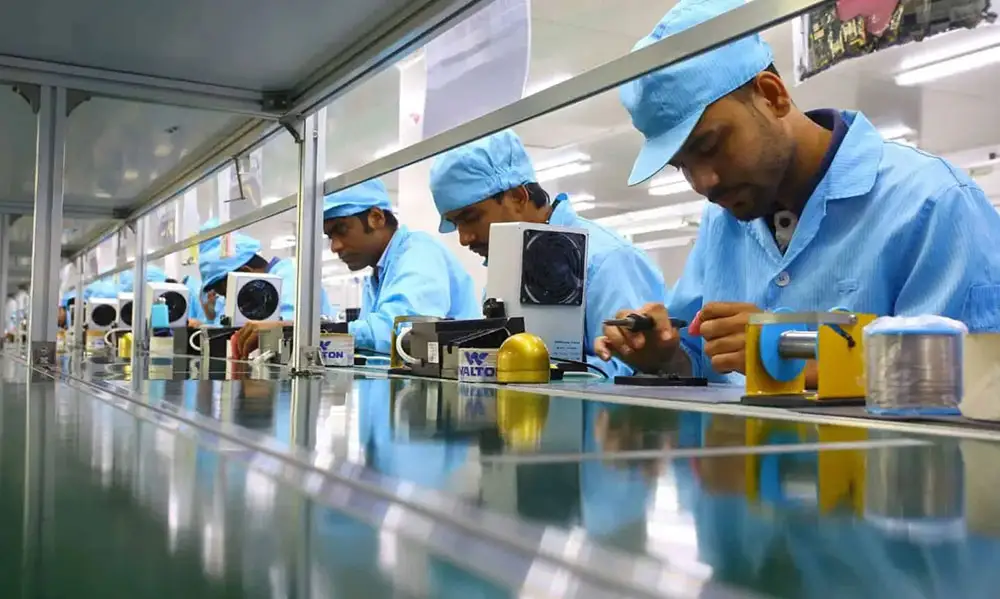
China perceives a sense of schadenfreude in New Delhi in the contretemps between Beijing and Washington. India has been trying to develop manufacturing capabilities lately, but China links it to Trump’s tariff war against Beijing during his first term. Its strategists feel that India was keen to benefit from this rupture in Sino-American ties and tried to revitalise the ‘Make-in-India’ campaign to improve manufacturing potential. According to the evidence, Chinese writings point to media reports that the Indian government had decided to earmark land parcels twice the size of Luxembourg in different states to house industrial units. This initiative was prompted by corporate houses voicing concerns about the protracted nature of land acquisition. But Beijing saw ulterior designs in New Delhi’s wooing of large multinational companies with offers of business-friendly policies.
During the Covid-19 pandemic, China shut down factories to stop the contagion, which resulted in shortages and price-gouging. In turn, India launched the ‘Aatma-Nirbhar’ campaign, which Beijing interpreted as a move to shift industrial supply chains away from it. Chinese writing says that India saw this period and the opportunities it offered as comparable to China’s industrialisation efforts between the 1980s and 1990s.
Cut to the current tariff war under Trump 2.0, Chinese commentators say that India again sees this as a ‘once-in-a-lifetime’ opportunity to relocate international production and supply chains and pursue industrialisation. As a result of this sustained effort by New Delhi, China evaluates that India’s industrial potential shows the characteristics of ‘diǎn zhuàng tūpò’ or ‘point-like breakthroughs’, essentially implying progress in foundational manufacturing of toys and smartphones. Trump singling out China paves the way for relatively lower levies on India, and there is a growing belief that India will leverage this situation to its advantage.
___________
Kalpit A. Mankikar is a Fellow with the Strategic Studies programme at the Observer Research Foundation
******