




Blitz Bureau
The Indian Navy formally inducted and named the ancient stitched ship as INSV Kaundinya last week at a ceremonial event held at naval base, Karwar, in Karnataka. Minister of Culture Gajendra Singh Shekhawat was the chief guest at the induction which marked the culmination of an extraordinary project that celebrates India’s rich shipbuilding heritage.
INSV Kaundinya is a stitched sail ship, based on a 5th century ship depicted in the paintings of Ajanta caves. The project was initiated through a tripartite agreement signed in July 2023 between the Ministry of Culture, the Indian Navy, and Hodi Innovations, with funding from the Ministry of Culture.
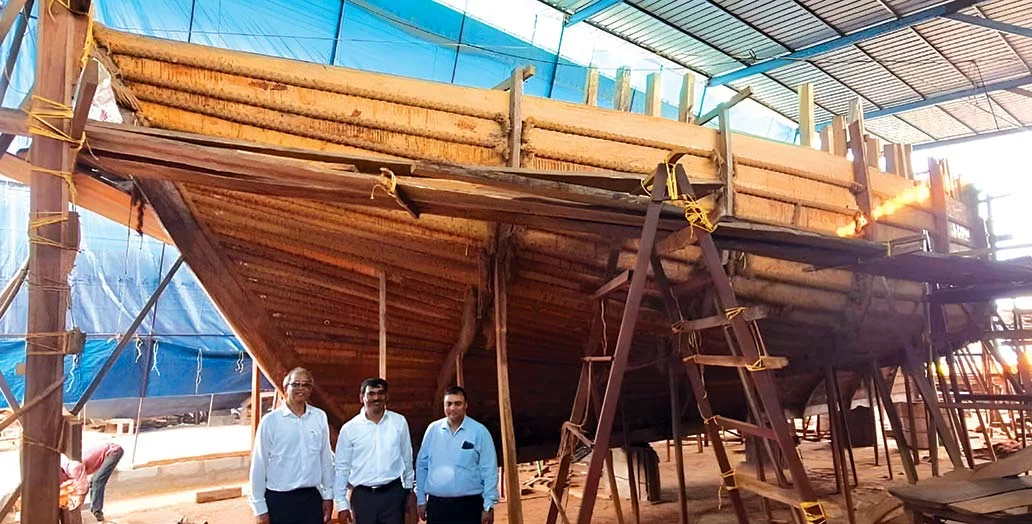
Following the keel laying in September 2023, the vessel’s construction was undertaken using a traditional method of stitching by a team of skilled artisans from Kerala, led by master shipwright Babu Sankaran. Over several months, the team painstakingly stitched wooden planks on the ship’s hull using coir rope, coconut fibre and natural resin. The ship was launched in February this year at Goa.
The Indian Navy played a central role in the project, overseeing the design, technical validation, and construction process. With no surviving blueprints of such vessels, the design had to be inferred from iconographic sources. The Navy collaborated with the shipbuilder to recreate the hull form and traditional rigging, and ensured that the design was validated through hydrodynamic model testing at the Department of Ocean Engineering, IIT Madras, and internal technical assessment.
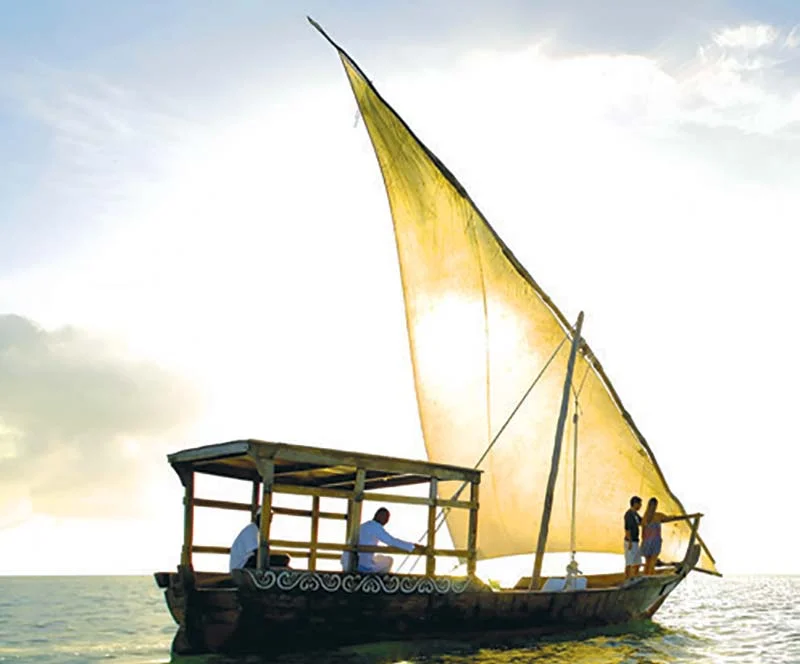
The newly inducted vessel incorporates several culturally significant features. Her sails display motifs of the Gandabherunda and the Sun, her bow bears a sculpted Simha Yali , and a symbolic Harappan style stone anchor adorns her deck, each element evoking the rich maritime traditions of ancient India. Named after Kaundinya, the legendary Indian mariner who sailed across the Indian Ocean to Southeast Asia, the ship serves as a tangible symbol of India’s long-standing traditions of maritime exploration, trade, and cultural exchange.
Inducted as an Indian Naval Sailing Vessel (INSV), Kaundinya will be based at Karwar. The ship will now embark on her next historic phase, involving preparations for a transoceanic voyage along the ancient trade route from Gujarat to Oman, scheduled for later this year.
The ‘stitched ship’ is a type of wooden boat which is “carvel” built with the planks stitched together with ropes, a technique popular in ancient India for constructing ocean going vessels prior to the advent of metallic fasteners. In boatbuilding, “carvel” refers to a method of construction where hull planks are laid edge-to-edge and fastened to a frame, creating a smooth, continuous surface.
Stitching up a ship
Stitched ships are extremely rare in modern times, but they are not entirely extinct. They are still used in a few traditional contexts, mostly for cultural or heritage purposes rather than mainstream commercial or military use.
India (especially coastal regions like Gujarat and Kerala): Traditional boatbuilding communities in places like Beypore (Kerala) and Mandvi (Gujarat) still occasionally use stitched construction techniques, particularly for dhows (or uru).
These vessels may use stitching with coconut coir and wooden pegs, often combined with some modern materials.
Such boats are mostly made for heritage, tourism, or special orders (such as for Gulf clients who want traditionally built vessels for cultural reasons).
Arabian Peninsula (Oman, UAE): Some traditional Omani dhow builders still maintain stitched boatbuilding methods for heritage or ceremonial purposes.
Oman has a long maritime history of sewn boats, and models or actual vessels are still made for museums, festivals, or sailing exhibitions.
Southeast Asia (Indonesia, the Philippines): In regions like Sulawesi (Indonesia) or the Sama-Bajau (sea nomads) communities in the Philippines, remnants of stitching techniques can be seen in some traditional boat types.
While nails and screws have mostly taken over, some artisanal efforts still revive or preserve the stitching method.
Experimental archaeology and maritime museums: Institutions like the Maritime Museum in Norway, or efforts like the Jewel of Muscat (a sewn dhow built in Oman and sailed to Singapore in 2010), demonstrate these techniques.
Such reconstructions are based on historical shipwrecks (such as the 9th century Belitung ship) and are used for educational and research purposes.