




Blitz India Business
Beneath every month’s oil-import bill sits a structural wager that will shape a decade: India is building clean power at a pace few economies can match, and the economics are starting to compound. The country now holds about 283 GW of non-fossil generating capacity — the world’s third-largest — crossed the 50% non-fossil-capacity mark around mid-2025, five years ahead of its Paris pledge, and added a record 55.3 GW of clean capacity in FY26 alone. The target is 500 GW by 2030. This is no longer an environmental aspiration; it is an industrial strategy with a balance-sheet logic.
The financial case is threefold. Every unit of solar or wind displaces imported fuel, trimming the oil-and-coal bill that widens the trade deficit and pressures the rupee. Every gigawatt built anchors domestic manufacturing — modules, cells, turbines, and increasingly the batteries that store the power — and the skilled jobs that come with it. And falling renewable tariffs steadily lower the cost of electricity for the factories and homes that drive demand. Clean energy, in short, is where India’s climate goals and its self-reliance ambitions point in the same direction.
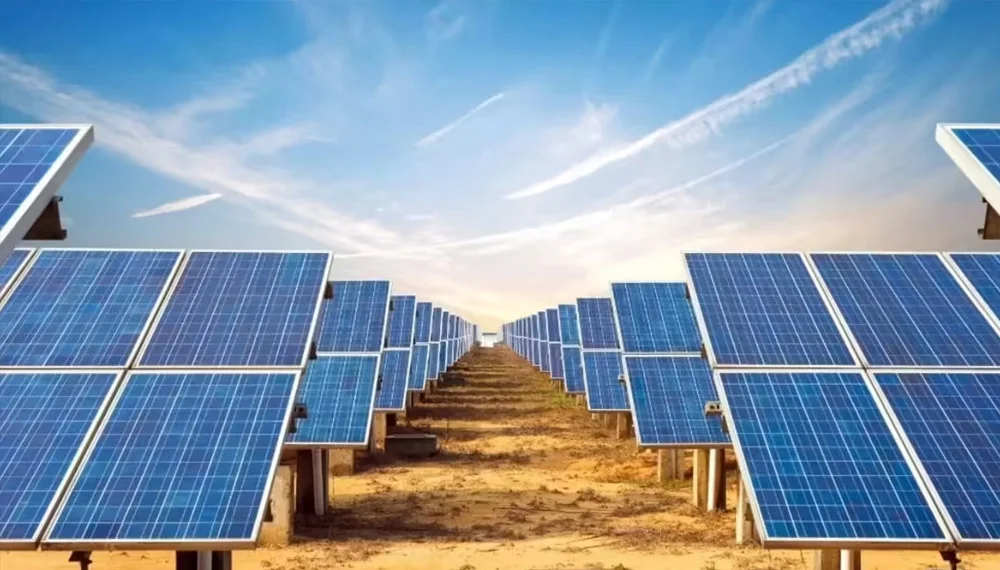
[ PHOTOGRAPH ] A large solar power plant in India, representing renewable energy capacity
An industrial bet: ~283 GW of non-fossil capacity, a record 55.3 GW added in FY26, and a 500 GW-by-2030 target — each gigawatt trims the import bill and anchors manufacturing at home.
A solar panel is a hedge you can see from the sky. Every gigawatt India builds is a barrel of imported oil it does not have to buy — and a factory it can build at home.
The Long View
• Capacity: ~283 GW non-fossil — the world’s third-largest
• Milestone: 50% non-fossil capacity reached ~mid-2025, five years early
• Momentum: record 55.3 GW of clean capacity added in FY26
• Target: 500 GW of non-fossil capacity by 2030
The honest account names what must be tended for the returns to keep compounding. The grid has to keep pace with generation, so clean power built in the desert reaches demand in the cities; storage — batteries and pumped hydro — must firm up sun and wind into round-the-clock supply; and domestic manufacturing has to deepen from assembly toward cells, wafers and battery chemistries so more of each gigawatt is genuinely made in India. Financing all of this at scale, at a reasonable cost of capital, is the quiet enabler beneath every megawatt.
The constructive, long-view read is that the energy transition is among India’s highest-return industrial bets — a rare policy where the climate case, the trade-balance case and the jobs case align. The way forward is to keep building generation while closing the gaps around it: grid, storage, and a domestic supply chain deep enough to capture the value at home. Handled with that discipline, a record year of clean-capacity additions becomes not a headline but a foundation — cheaper power, a lighter import bill, and a manufacturing base that grows with every panel and cell India learns to make itself.