




Blitz India Business
NEW DELHI: India’s HSBC Manufacturing PMI stood at 54.2 in June, down from 55.0 in May and revised below the preliminary 54.5 — comfortably in expansion, but the second-weakest improvement in factory activity since mid-2022. Inside that headline is a divergence worth building a decade of policy around. Output and new orders slowed to among their weakest rates in four years, and export orders rose at the softest pace since March 2023 on subdued demand from some European markets. India’s factories are growing on domestic demand. They are struggling to grow on foreign demand. Those are different problems with different solutions.
The domestic side is genuinely working, and the industrial-policy data shows where. Under the Production Linked Incentive scheme for automobiles and auto components, Maharashtra leads with 66 manufacturing units established as of March 31, 2026, with Tamil Nadu second at 38 — a geographic concentration that reflects existing supplier ecosystems rather than incentive design, and that tends to compound. India Semiconductor Mission 2.0, cleared this month with a ₹1.27 lakh crore outlay, extends the same logic into electronics with explicit coverage of equipment, materials and packaging. These are competent, well-targeted interventions and the capacity they are producing is real.
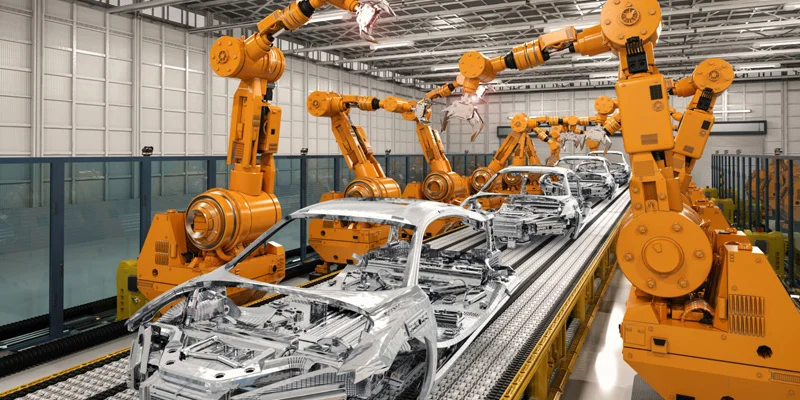
Capacity built, competitiveness pending: PLI has produced units on the ground — 66 in Maharashtra, 38 in Tamil Nadu for autos alone — while export order growth has slowed to a three-year low.
Incentives can build a factory. Only logistics costs, power reliability and trade access decide whether what comes out of it can win an order in Rotterdam.
At a Glance
• Manufacturing PMI: 54.2 in June 2026, from 55.0 in May; revised down from a 54.5 flash reading
• Character: second-weakest improvement since mid-2022; output and new orders near four-year lows
• Exports: new export orders grew at the softest pace since March 2023
• PLI-Auto footprint: Maharashtra 66 units, Tamil Nadu 38, as of March 31, 2026
• Semiconductors: ISM 2.0 approved July 2026 with a ₹1.27 lakh crore outlay
• Trade access: India–UK CETA live since July 15; India–US arrangement still under negotiation
The export problem is structural and largely not about the factory floor. An Indian manufacturer competing into Europe carries logistics costs and transit times that its East Asian competitors do not, power costs and reliability that vary sharply by state, working-capital cycles lengthened by compliance and refund timelines, and a trade-access position that is improving but incomplete. Each of these is a wedge between factory-gate cost and landed cost, and it is landed cost that wins the order. A firm can be efficient at the machine and uncompetitive at the port, and no production incentive fixes that gap.
Which is why the constructive agenda for the coming decade points away from more incentives and towards the wedge itself — and much of it is already underway. Trade access is being addressed directly: the India–UK CETA has been live since July 15 with zero duty on almost 99% of Indian export lines, and the US negotiation is being run for relative advantage rather than speed. Logistics costs are the target of the national infrastructure build and of digitised, single-window customs processing, where transit-time reduction is measurable and should be published. Power reliability is a state-level variable, which argues for open, comparable state-wise industrial tariff and outage data so that competition between states does its work. And the single highest-return item is the least discussed: predictable, quick input-tax refunds, because a compliance delay is a working-capital cost that falls hardest on exactly the mid-sized exporters who most need to scale. India has spent a decade proving it can build manufacturing capacity. The measure that matters for the decade ahead is not units established but export orders won — and that number is decided almost entirely outside the factory gate.