




Blitz Bureau
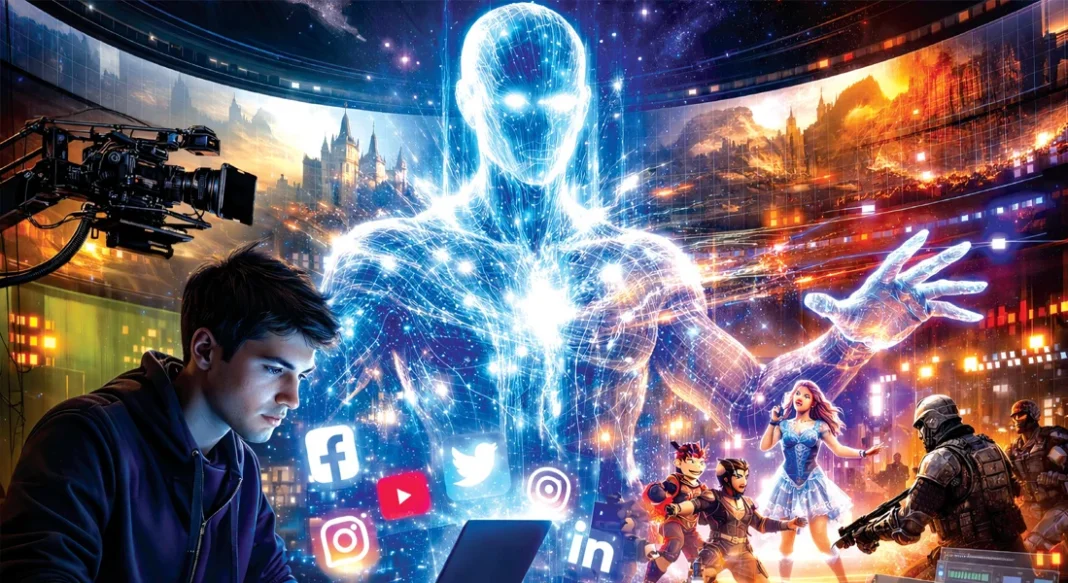
NEW DELHI: In the neon-lit gaming studios of Bengaluru, the high-octane film sets of Mumbai, and even the “content villages” of rural Uttar Pradesh, a fundamental shift has reached its tipping point.
As we navigate the first quarter of 2026, the collision of the Orange Economy — the collective of industries rooted in individual creativity and intellectual property — and Digital India 2.0 has rewritten the nation’s economic script.
India is shedding its skin as the world’s “back office” for IT maintenance. In its place is a new identity: the global “front office” of creative IP. Powered by a sovereign AI infrastructure and a decentralised digital architecture, the country is witnessing a surge in creative output that experts project will pump over $50 billion into the GDP by 2029.
Rise of the “co-creator” AI
For decades, technology in the arts was a utility — a faster way to colour-grade a film or a more efficient way to compress audio. In 2026, the paradigm has shifted from automation to co-creation.
The “Orange Economy” now breathes through artificial intelligence. In the Indian film industry, predictive AI models aren’t just crunching numbers; they are helping directors analyse narrative pacing and audience sentiment before the first camera rolls.
This isn’t about replacing the “human touch” but liberating it. Independent filmmakers, once crushed by the massive capital requirements of traditional studios, are now using generative AI to render visual effects that previously cost millions. The barrier to entry has collapsed, allowing a storyteller in a small town to compete with a legacy studio on a global stage.
The music industry has seen an equally seismic shift with the emergence of “Voice DNA.” In a world where AI can replicate any sound, India has led the way in creating ethical frameworks.
Our iconic vocalists and rising stars now license their “digital timbres,” ensuring they receive royalties every time their AI-cloned voice is used in a new composition. This fusion of IP protection and technological flair is a hallmark of the 2026 landscape.
Digital India 2.0: From access to impact
If the first decade of Digital India was about “pipes”— bringing 4G and fiber to the hinterlands — Digital India 2.0 is about the “flow.” India is now the most data-dense market on the planet, with broadband subscriptions having crossed the one-billion mark.
However, the real story isn’t the number of people online; it’s the explosion of platforms that have democratised the economy. Central to this is the Open Network for Digital Commerce (ONDC).
By unbundling the seller from the platform, ONDC has allowed local artisans and digital creators to escape the “walled gardens” of global tech giants. An animator in a tier-2 city can now list their services on a unified network, reaching international buyers without losing a third of their revenue to middle-man fees.
Infrastructure of sovereignty
At the heart of this transformation is the IndiaAI Mission. Recognising that data is the “new oil” but “compute” is the “new refinery,” the Government has aggressively expanded its sovereign AI capabilities. By early 2026, the national grid boasts 58,000 GPUs, providing the raw horsepower required to train “India-first” AI models.
This “Sovereign AI” approach ensures that Indian cultural nuances — our 22 official languages, our diverse aesthetic traditions, and our unique folk rhythms — are baked into the algorithms.
Through the Bhashini platform, AI now provides real-time, voice-based translation. This has effectively broken the final barrier to a truly national creative market, allowing a Malayalam-speaking scriptwriter to collaborate seamlessly with a Marathi-speaking illustrator.
The “Create in India” mandate
The policy focus has pivoted from “Make in India” to a broader “Create in India” mission. The Ministry of Information and Broadcasting (MIB) has rolled out AVGC (Animation, Visual Effects, Gaming, and Comics) Content Creator Labs in over 15,000 schools and colleges.
These labs aren’t just teaching kids how to code; they are teaching them how to prompt, curate, and directAI. The curriculum focuses on “AI-native” storytelling, ensuring that the next generation is equipped to lead the global gaming industry — a sector already valued at nearly ₹232 billion ($2.8B) in India this year.
Ethics of the new era
With this unprecedented power comes the need for rigorous guardrails. The IT Amendment Rules of 2026 have introduced a sophisticated framework for managing AI-generated content. Every piece of “synthetically generated information” (SGI) must now carry a digital watermark and tamper-proof metadata.
The “3-Hour Takedown” rule for harmful deepfakes has become a global gold standard for protecting public discourse. This regulatory clarity has given investors the confidence to pour capital into Indian AI startups, knowing that the legal landscape is both predictable and protective of creators’ rights.
A global beacon
As we look toward the end of the decade, the synergy between the Orange Economy and Digital India 2.0 offers a blueprint for the global south. India is proving that a nation can embrace the cutting edge of AI while simultaneously empowering its grassroots creators.
The explosion of data hasn’t led to digital chaos; instead, it has fueled a structured, platform-led renaissance. In the 2026 economy, the most valuable currency is no longer just a line of code or an hour of labour — it is the Indian imagination, scaled by AI and delivered by a digital infrastructure that truly belongs to the people.
Where tech is the real hero
While the creative output of the Orange Economy captures the headlines, the real “engine room” of 2026 is buried in the massive data centers of the IndiaAI Mission. To understand why India is leading the global AI transition, look at the four pillars of its “Silicon Backbone.”
The GPU democratisation
In 2024, India faced a “compute crunch.” Today, through a ₹10,300 crore outlay, the Government has democratised access to high-end hardware. Startups and researchers can now rent time on the national Shakti Cloud for as little as ₹65 per hour. This “AI-as-a-Service” model has leveled the playing field, allowing small-town developers to train large language models (LLMs) that rival those of Silicon Valley.
AIKosh: National data lake
Digital India 2.0 has solved the “garbage in, garbage out” problem through AIKosh. This centralised repository holds over 5,500 curated, non-personal datasets across sectors like agriculture, health, and urban planning. For an app developer, AIKosh provides the “ground truth” data needed to build applications that actually work in the Indian context.
The “Bhashini” bridge
Language has historically been the biggest barrier to the “explosion” of apps in India. The Bhashini AI stack has changed the game. By providing an open API for real-time translation in 22 languages, it has enabled “Voice-First” commerce. In 2026, more than 60 per cent of new internet users in India interact with apps primarily through voice commands in their mother tongue.
Convergence via ONDC
The Open Network for Digital Commerce (ONDC) is the connective tissue. It acts as the infrastructure that allows a creator to become a merchant. By standardising the way apps “talk” to each other, ONDC ensures that a small digital platform can tap into a national logistics and payment grid instantly. It is the ultimate decentralisation of power, moving control from global gatekeepers to millions of local participants.