


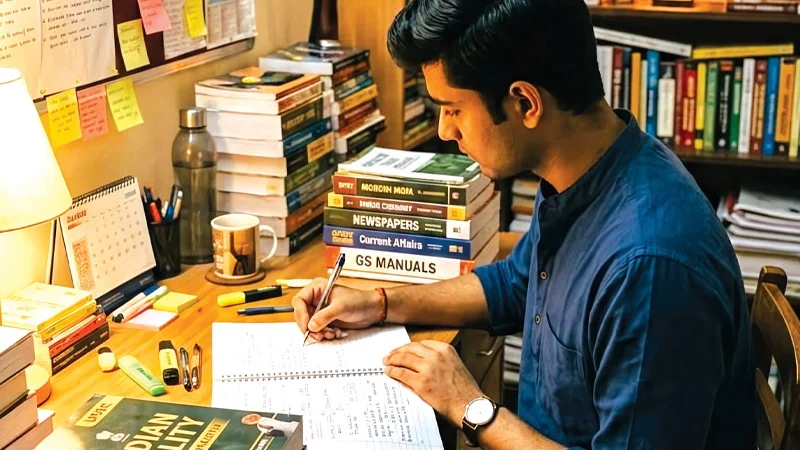


Shalini S Sharma
NEW DELHI: The unprecedented move by the Central Government to actively consider the deployment of Indian Air Force (IAF) aircraft to transport question papers for the upcoming NEET-UG re-test on June 21, highlights a severe crisis of credibility in India’s examination system.
Bringing military logistics into a civilian academic exercise follows the disastrous cancellation of the May 3 exam due to a massive paper leak originating from Latur, Maharashtra and Sikar, Rajasthan. The fact that the state machinery feels compelled to secure examination papers with the same rigour as national defence assets is a stark indicator of the intense pressure cooker of India’s competitive exam ecosystem.
The universe of India’s high-stakes competitive exams
India’s competitive examination landscape is a vast, complex, and intensely demanding universe. For a significant portion of the country’s youth, these exams are not merely academic hurdles; they are the sole, definitive arbiters of future socio-economic mobility.
At the base of this pyramid are school-level talent search exams and Olympiads, acting as early conditioning for the gruelling battles ahead. The real crucible begins after high school:
National Eligibility cum Entrance Test (NEET): The singular gateway for entry in undergraduate medical (MBBS), dental (BDS) and Ayush courses in Government or private medical colleges.
Joint Entrance Exam (JEE) – Main and Advanced: The ultimate filters for prestigious engineering institutes such as the IITs and NITs.
Union Public Service Commission (UPSC) Exams: The holy grail for administrative aspirations.
Common Law Admission Test (CLAT): The path for the judiciary and corporate law.
This system operates on a simple, brutal premise: elimination rather than selection. In a nation where demographic dividends often clash with a lack of proportionate infrastructural and economic growth, these exams are viewed as the only legitimate escape velocity from middle-class obscurity or rural poverty.
The staggering numbers: Students versus seats
The sheer arithmetic of India’s exam ecosystem is what drives the desperation that drives the use of military transport for test papers. The numbers involved create a supply-demand mismatch that borders on the absurd.
NEET-UG 2026: Nearly 2.3 million candidates registered to compete for approximately 110,000 MBBS seats across the country. Only about half are in Government colleges offering affordable fees, translating to an acceptance rate of barely 2.5 per cent for Government seats.
JEE: Over 1.2 million students routinely appear for the JEE Main, vying for a chance to sit for the JEE Advanced. Ultimately, only about 17,000 seats are available across the 23 Indian Institutes of Technology (IITs), making the acceptance rate less than 1.5 per cent.
UPSC: Annually, over 1 million candidates apply, battling through Prelims, Mains, and Interviews for roughly 1,000 vacancies—a success rate of 0.1 per cent.
The scarcity of high-quality, publicly funded higher education institutions and stable white-collar jobs transforms these exams into a zero-sum game, pushing candidates and their families to extreme measures to secure an edge.
At stake: The dream of lucrative careers
Millions of teenagers willingly subject themselves to years of monastic isolation, gruelling study schedules, and immense psychological pressure because of the profound societal and economic rewards attached to these professions. In India, a career in these fields is a permanent elevation in social standing.
Doctors (NEET): Carries an aura of near-divinity. Beyond the immense social reverence, it offers unparalleled job security and the potential for a highly lucrative private practice. Becoming a doctor is often viewed as a generational leap in status.
Engineers (JEE): The IIT tag is synonymous with global mobility and elite corporate success. It is the accepted passport to Silicon Valley, top-tier management consulting, and high-paying tech jobs.
Administrative services (UPSC): The Indian Administrative Service (IAS) and Indian Police Service (IPS) offer a unique blend of immense executive power, iron-clad job security, and unparalleled social prestige.
Judiciary and law (CLAT): Top-tier National Law Universities (NLUs) provide direct access to high-paying corporate law firms and a stable pathway to becoming a judge.
These careers represent the apex of middle-class aspiration. Failing to secure these positions often feels like a failure at life itself, intensifying the pressure to succeed at any cost.
Multibillion-dollar prep industry ecosystem
Wherever there is a bottleneck, an industry emerges to sell a way through it. The coaching and test-prep industry in India is a multibillion-dollar behemoth that operates parallel to the formal education system.
The economics: Parents routinely pay between ₹1 lakh to ₹3 lakh annually for coaching fees alone. In cities like Kota or Sikar, the coaching ecosystem is the primary economic engine, driving 30 per cent to 35 per cent of the local GDP.
The gamut and ancillary services: The core product — classroom teaching and test series — is supported by an entire ancillary universe. This includes specialised real estate (hostels, paying guest accommodation), massive catering and mess services, localised transportation, and psychological counselling centers.
The industry has also aggressively expanded into the digital realm, with ed-tech platforms democratising access through cheaper online subscriptions and tapping into the vast rural and semi-urban markets.
The ecosystem is designed to isolate the student from everything except their preparation, creating controlled environments where the only metric of a student’s worth is their mock-test score.
Major players: numbers and reputation
The prep industry is dominated by a mix of legacy brick-and-mortar giants and heavily funded ed-tech disruptors. Brands like Allen Career Institute, Aakash Institute, FIITJEE, and Resonance boast hundreds of centers nationwide and enroll millions of students annually. Digital-first giants like Physics Wallah revolutionised the space with highly affordable online courses before aggressively expanding into offline centers.
The reputation of these major players is highly polarised.
The good: Celebrated for their results, rigorous testing methodologies, and an undeniable track record of producing top rankers. They provide structured, high-quality material that the standard school system often fails to deliver.
The bad: Heavily criticised for fostering toxic, hyper-competitive environment. They face allegations of deceptive marketing and commodifying education, where “star” batches receive top-tier faculty, while average students are treated merely as revenue streams to fund the scholarships of the elite few.
India’s competitive examination landscape is a vast, complex, and intensely demanding universe. For a significant portion of the country’s youth, these exams are not merely academic hurdles; they are the sole, definitive arbiters of future socio-economic mobility.
Unseen cost of paper leaks
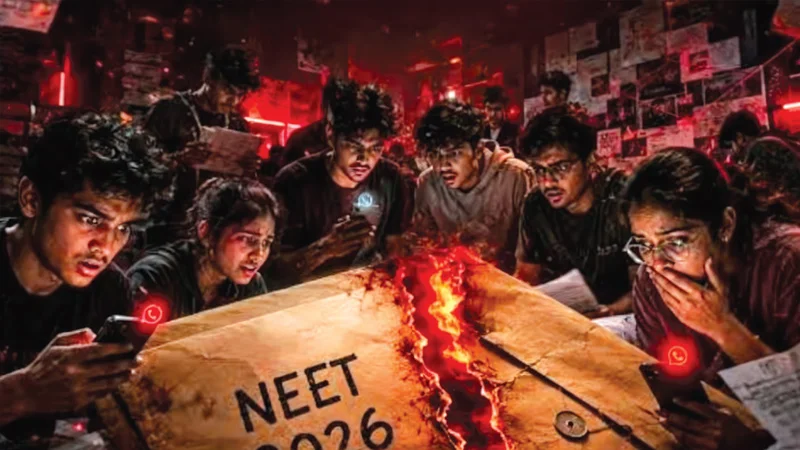
While police and politicians focus on the mechanics of paper leaks and military logistics, the most devastating casualty of an eventuality like the NEET-UG 2026 fiasco is the mental well-being of aspirants. The sudden cancellation of the examination triggered a wave of profound emotional distress across coaching hubs like Jaipur, Kota, and Sikar.
For students, preparing for high-stakes exams is an exercise in extreme psychological endurance. It involves years of missed family events, truncated social lives, and relentless pressure.
When the news of a cancellation broke, psychiatrists and counsellors witnessed an alarming spike in students suffering from panic attacks, acute insomnia, and clinical depression. The re-test, scheduled a mere 38 days later on June 21, forced exhausted teenagers to abruptly restart a high-stress cycle they believed they had just survived.
The trauma is compounded by severe financial guilt. Many students hail from rural, agrarian families who take high-interest loans or sell land to afford the steep coaching fees and hostel rents. A cancelled exam means extended stays, more rent, and prolonged financial bleeding for their parents.
This environment becomes a powder keg when institutional trust is broken. A paper leak tells an honest student that merit is secondary to money and connections. As the Government attempts to fortify the system with Air Force planes and strict surveillance, the true challenge remains unaddressed: healing a generation of students who feel betrayed by the very system they have sacrificed their youth to conquer.
One problem
The introduction of the “One Nation, One Exam” model has fundamentally changed the risk profile of competitive testing in India. The stakes for students as well as parents have gone up astronomically with the shift to centralised exams like NEET and CUET.
Under the old decentralised system, a medical aspirant might appear for the central AIPMT, their specific State PMT, and perhaps exams for institutions like AFMC, AIIMS, or private college consortiums like COMEDK.
If a student fell ill, panicked, or simply had a bad day during one exam, they had three or four other chances in the same month. Today, there is no backup. A single 200-minute window dictates an entire year of preparation. This “all-or-nothing” dynamic is exactly what has caused the pressure, coaching dependency, and desperation (leading to paper leaks) to skyrocket.
Centralised system – one exam model
A centralised system consolidates all admissions for a specific field into a single, national examination conducted by a central authority like the National Testing Agency (NTA).
| Aspect | Pros of centralisation | Cons of centralisation |
|---|---|---|
| Logistics & cost | Students pay one application fee and travel to one centre, removing the financial and physical exhaustion of giving 5-6 different exams. | The immense scale (millions of students) creates massive logistical nightmares for the organising body to conduct it flawlessly in a single day. |
| Standardization | Creates a uniform benchmark of merit. A rank obtained is standardised across the entire country, theoretically providing a level playing field. | Heavily favours the central CBSE / NCERT syllabus. Students studying under regional state boards are at a distinct disadvantage. |
| Transparency | Curtailed the unchecked power of private colleges, significantly reducing the “capitation fee” (donations) menace that thrived under private entrance exams. | Single-point vulnerability: If the paper leaks at a single regional center, the entire national exam is compromised, forcing millions to suffer for a localised failure. |
| Psychological Impact | Students only have to focus on mastering one syllabus and one exam pattern, rather than juggling varying requirements. | Hyper-pressure: The lack of a backup option creates extreme anxiety. One bad day results in a forced drop-year, driving severe mental health crises. |
Decentralised system – Pre-2013 state & Central model
Under the decentralised system, the Central Government held exams for Central institutes, while each state and private consortium held their own independent entrance tests.
| Aspect | Pros of decentralisation | Cons of decentralisation |
|---|---|---|
| Risk mitigation | Compartmentalised risk: A paper leak or administrative failure in one state’s exam did not derail the academic calendar for the rest of the country. | Varying difficulty: A state exam might be much easier than a central exam, meaning “merit” was not uniform across state lines. |
| Multiple opportunities | Built-in backups. Students could take multiple exams, ensuring that a single panic attack or illness did not cost them a year of their life. | Wealthier students had an unfair advantage, as they could afford the exorbitant application fees and travel costs to take exams in 5 or 6 different states. |
| Regional Equity | State exams were directly aligned with state board curricula and often conducted in regional languages, levelling the field for rural and state-educated youth. | High levels of corruption. Private medical and engineering colleges routinely manipulated their own independent entrance exams to sell seats to the highest bidder. |