





Blitz Bureau
NEW DELHI: After independence, companies in India operated within structured legal frameworks supporting normal business activities. When financial stress emerged, they relied on multiple legal mechanisms for resolution. These included company law, debt recovery processes and secured creditor frameworks. Each mechanism followed separate forums and procedures. This often made coordination complex and time-consuming.
To address these challenges, the Government introduced the Insolvency & Bankruptcy Code, 2016. It consolidated existing laws into a single system. The Code also strengthened creditor participation and aimed to maximise asset value, while balancing the interests of all stakeholders.

As the system evolved, implementation experience highlighted areas for improvement. Refinements were introduced to enhance efficiency and outcomes. This continuous reform process led to the enactment of the Insolvency & Bankruptcy Code (Amendment) Act, 2026, marking the next phase of consolidation.
The need for reform
Before the IBC enactment, insolvency resolution operated through multiple overlapping legal frameworks. These processes functioned through separate institutions and forums, often resulting in fragmented proceedings and overlapping jurisdiction. As a result, resolution processes frequently became prolonged and uncertain.
Cases remained pending for years while the value of distressed assets continued to deteriorate. Delays weakened the ability of creditors to recover dues and reduced the possibility of reviving viable businesses. The absence of a consolidated and time-bound mechanism also affected overall credit discipline and investor confidence.
The Insolvency & Bankruptcy Code, 2016 established a unified framework for resolving insolvency across companies, partnership firms and individuals. It consolidated multiple insolvency laws into a single structure, creating a more coordinated and predictable resolution process.

A key objective introduced by the Code was the transition from a debtor-controlled system towards a creditor-driven resolution framework. The emphasis moved beyond mere recovery proceedings towards value maximisation, continuation of viable businesses and balanced treatment of stakeholders.
A structural mechanism
At the centre of the framework is the Corporate Insolvency Resolution Process (CIRP), which provides a structured mechanism for resolving corporate insolvency. The Committee of Creditors (CoC), comprising financial creditors, evaluates resolution plans. They then make important commercial decisions regarding the future of the stressed entity.
The Code also introduced a time-bound structure for resolution. The CIRP was designed to be completed within 180 days, extendable up to 330 days in specified circumstances. If a resolution is not achieved within the prescribed framework, the entity moves into liquidation in accordance with the provisions of the Code.
The effectiveness of the IBC framework rests on a regulated institutional ecosystem established under the Code. The Insolvency and Bankruptcy Board of India functions as the regulatory authority
The effectiveness of the IBC framework rests on a regulated institutional ecosystem established under the Code. The Insolvency and Bankruptcy Board of India (IBBI) functions as the regulatory authority responsible for overseeing insolvency processes, Insolvency Professionals (IPs) and related institutions under the framework.
IPs administer the affairs of distressed entities, safeguard assets and facilitate meetings of creditors. They oversee the resolution process in compliance with the Code and applicable regulations.
Strengthened ecosystem
Also, the corporate insolvency matters are adjudicated by the National Company Law Tribunal (NCLT), which acts as the adjudicating authority. Appeals against its decisions are heard by the National Company Law Appellate Tribunal (NCLAT).
Since its enactment, the IBC has significantly strengthened the country’s insolvency and credit ecosystem. Till March this year, 8,987 CIRPs have been admitted under the Code. A total of 1,419 corporate debtors were resolved through approved resolution plans, while several other cases were closed through settlements, appeals, reviews and withdrawals under section 12A.
At the same time, operational challenges continued to remain. Average resolution timelines in several cases exceeded the statutory limit of 330 days. Delays in adjudication and prolonged litigation affected value maximisation in some proceedings. Despite these challenges, the Insolvency Bankruptcy Code is a major structural reform in India’s financial and corporate resolution framework.
An evolving framework
The reform leading to the Insolvency & Bankruptcy Code (Amendment) Act, 2026 is built on the evolution of the insolvency framework through a series of legislative amendments. The key amendments include:
2018 Amendment: Introduced significant refinements to the resolution framework, including provisions for withdrawal of applications and changes in voting thresholds. It further strengthened creditor participation and modified eligibility criteria under Section 29A of the principal act.
2019 Amendment: Improved the insolvency resolution framework by introducing an overall time limit of 330 days for completion of the process.
2020 Amendment: Introduced key safeguards, including immunity for corporate debtors after resolution. It also suspended insolvency proceedings for specified defaults in response to COVID-19.
2021 Amendment: Introduced the pre-packaged insolvency resolution process for MSMEs, enabling faster debtor-in-possession resolution with creditor supervision and oversight. It also included provisions to improve efficacy and timelines in insolvency proceedings.
Reforms across stages
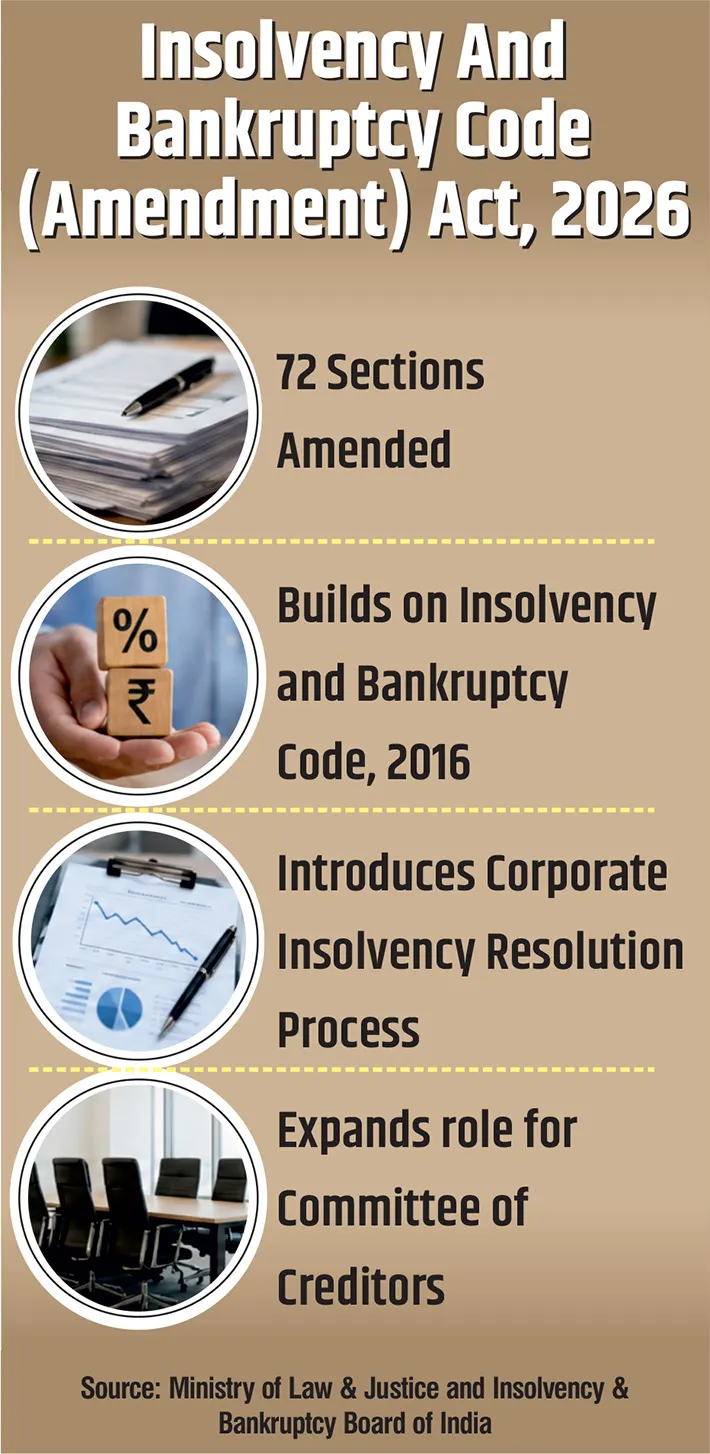
The Amendment Act of 2026 builds upon the Insolvency and Bankruptcy Code, 2016 after nearly a decade of implementation experience. It seeks to address procedural delays, litigation arising from legal ambiguities and operational challenges during insolvency resolution and liquidation proceedings.
The Act introduces reforms across different stages of the insolvency process. It strengthens timelines for admission and approval of cases. It expands the role of the CoCs during liquidation. It also clarifies provisions relating to security interests, avoidance transactions and resolution plans.
The amendment introduces safeguards for implementation of approved resolution plans. A key feature of the amendment is the introduction of a creditor-initiated insolvency resolution process for specified categories of corporate debtors.
Overall, the amendment seeks to make the insolvency framework more time-bound, predictable and resolution-oriented while retaining the core structure of the Insolvency and Bankruptcy Code, 2016.
Towards a more efficient framework
Over the past decade, the Insolvency and Bankruptcy Code, 2016 has reshaped India’s insolvency resolution framework. It introduced a more structured and creditor-driven approach towards financial distress.
The framework also evolved through implementation experience, judicial interpretation and legislative reforms.
The Insolvency and Bankruptcy Code (Amendment) Act, 2026 represents the next stage of this evolution. The amendment seeks to improve procedural certainty and strengthen timelines. It also aims to enhance the effectiveness of insolvency resolution and liquidation proceedings.
Together, these reforms support a more efficient and predictable insolvency framework in India.
Thumbs-Up from IIMs
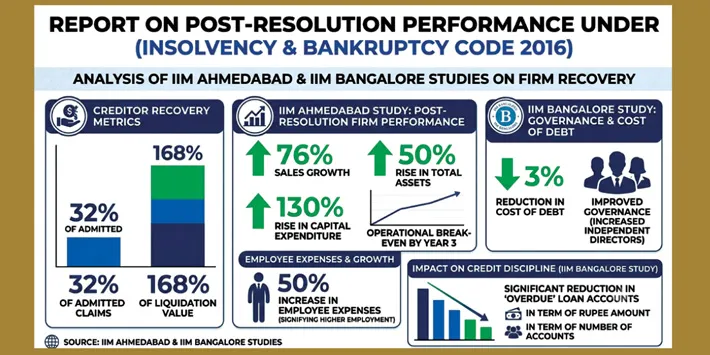
An IIM Ahmedabad study reveals strong post-resolution recovery among resolved firms under the Insolvency & Bankruptcy Code 2016.
Creditors recovered 32 per cent of admitted claims and 168 per cent of liquidation value. Resolved firms saw 76 per cent sales growth, reached operational break-even by the third year and experienced a 50 per cent rise in employee expenses meaning higher employment.
The total assets of the resolved companies grew by 50 per cent, capital expenditure rose 130 per cent, and profitability aligned with industry benchmarks.
Additionally, an IIM Bangalore study shows a 3 per cent reduction in the cost of debt and improved governance through increased independent directors. Thus, these studies demonstrate that firms undergoing resolution through the IBC process have shown significant improvements in various aspects of their business, including sales, profitability, asset growth, market valuation and liquidity.
Further, the impact of the IBC on credit discipline has also been corroborated by a comprehensive study conducted by IIM Bangalore. It finds that IBC has prompted borrowers to adhere to stipulated loan payment schedules.
During the period under review, the study notes a significant reduction in loan accounts deemed ‘Overdue’, both in terms of the Rupee amount as well as in terms of the number of accounts.