




Blitz Bureau
NEW DELHI: When Prime Minister Narendra Modi’s Government declared India the world’s second-largest mobile phone manufacturer, the announcement was greeted with justified pride.
In a decade, the country had moved from importing 75 per cent of its handsets to barely importing any at all. The value of mobile production has surged from ₹18,900 crore in 2014 to ₹4,22,000 crore in 2024. Apple’s suppliers alone shipped iPhones worth $12.8 billion from Indian shores in 2024 — a 42 per cent rise in a single year.
Foxconn invested ₹9,100 crore, overtaking its own Government target. By September 2025, India had overtaken China as the top smartphone exporter to the United States, with a staggering 240 per cent jump in volumes.
These are extraordinary achievements. But they are, in a phrase that is becoming uncomfortably familiar among industry insiders, a hollow boom.
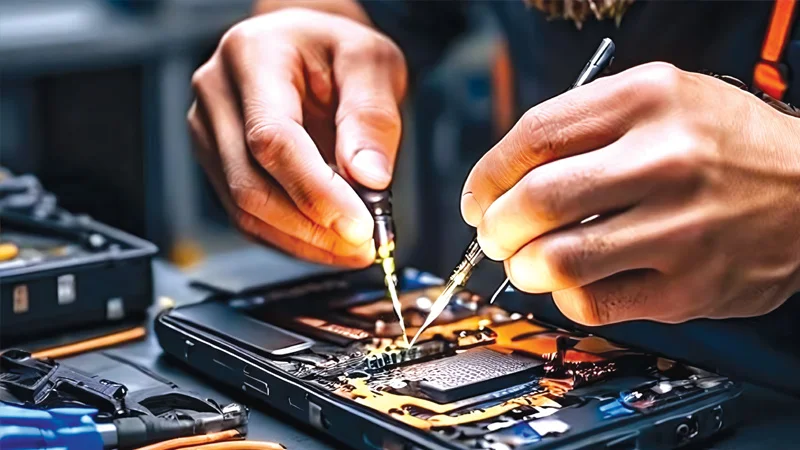
The production model remains essentially one of final assembly — what the industry calls ‘box-building’. India screws together phones, packages them, and ships them. But the brain of every device – the semiconductor chipset – is designed elsewhere and fabricated elsewhere.
The display, the camera sensor, the advanced printed circuit board: All imported, predominantly from China. Of every rupee of value in a smartphone made in India, only 23 paise of genuine value is actually added here. The rest belongs to foreign supply chains.
Nearly 40 per cent of all electronic components come from Chinese supply chains, creating a strategic vulnerability that no amount of final assembly can disguise.
The PLI scheme has attracted $33 billion in investment and made Apple’s India exports surge to $4.4 billion in just the first half of 2025. But this success is concentrated at the top: only Foxconn, Tata Electronics, and a handful of others are growing.
Smaller manufacturers face idle plants and mounting losses. The scheme formally ended in March, raising urgent questions about what sustains the ecosystem now, since the subsidies have disappeared — and whether India can move from a box-builder to a genuine technology manufacturer.
India exported $38.56 billion in electronics in 2024-25 while importing $36.8 billion in components. The net gain is real but razor-thin — and entirely dependent on foreign goodwill and geopolitical stability.
Unspoken China dependency
India’s relationship with Chinese electronics components is the open secret at the heart of its manufacturing ambition. Nearly 40 per cent of all electronic component imports come from China, with another 16 per cent routed through Hong Kong. This is not merely an economic dependency — it is a strategic vulnerability in an era when Beijing has already demonstrated its willingness to use export controls of critical goods as geopolitical leverage.
The Government’s Electronics Component Manufacturing Scheme (ECMS) and the Semicon India programme are genuine attempts to build indigenous capability. India approved its first seven semiconductor-related projects in 2025. But the combined value of those approvals — $626 million — is a fraction of what China, South Korea, or Taiwan have invested in chip fabrication over decades.
Industry analysts are frank: India is at least a generation behind in semiconductor manufacturing, and catching up requires not just money but decades of institutional knowledge, specialised talent, and infrastructure that simply does not yet exist.
The Phased Manufacturing Programme has delivered genuine results in simpler components — batteries, chargers, and printed circuit boards are now largely made domestically. But the progression from these into advanced displays, chipsets, and camera modules is a qualitative leap, not a linear one. Each step requires cleanroom environments, precision automation, and a supplier ecosystem that India is still constructing from scratch.
Consumers frustrated
For the ordinary Indian consumer, the manufacturing boom has brought more affordable devices, more domestic jobs, and a growing sense of national technological pride. But it has also brought a set of persistent frustrations that rarely make headlines.
One in four smartphone owners in major Indian cities visits a service centre within six months of purchase — a figure that speaks to quality issues that brand marketing carefully obscures. After-sales service quality drops sharply outside tier-1 cities, leaving hundreds of millions of consumers in tier-2 and tier-3 towns dependent on unauthorised repair shops that often lack spare parts, trained technicians, or accountability.
The grey and counterfeit market remains a serious problem. Online buyers regularly report receiving pre-activated or tampered handsets from unauthorised resellers. Counterfeit phones — built with substandard components that can cause fires or electric shocks — still circulate in rural and semi-urban markets where consumers have limited access to authorised retail channels and fewer means of verifying a device’s authenticity.
The Government’s response, mandating pre-installation of the Sanchar Saathi cybersecurity app on all new phones from late 2025, has helped recover over 700,000 stolen devices. But digital rights advocates warn that a Government app that cannot be uninstalled raises troubling questions about surveillance — a tension between consumer protection and civil liberties that remains unresolved.
Meanwhile, the Right to Repair framework — proposed by the Department of Consumer Affairs to allow third-party repair and force manufacturers to publish service manuals — has stalled at the consultation stage.
Consumers remain locked into manufacturer-controlled repair ecosystems, paying premium prices for out-of-warranty servicing or simply replacing devices they could afford to fix.
The e-waste emergency
If India’s manufacturing story is one of ambition outrunning infrastructure, its e-waste story is one of policy outrunning enforcement — with deeply human consequences.
India generates approximately 2.3 million tonne of electronic waste every year and is the world’s third-largest producer of e-waste after China and the United States. The figure has grown by over 150 per cent in six years. And yet, by every credible estimate, between 90 and 95 per cent of this waste never reaches a licensed recycler.
It flows instead through the kabadiwala network — the informal scrap traders who are present on every street corner in every Indian city — into unregulated backstreet workshops where the real recycling happens. In these workshops, circuit boards are dipped in acid baths to leach out gold. Wires are burned to extract copper.
Components are hammered apart by hand. The workers, many of them women and children, do this without gloves, ventilation, and without any understanding of what the toxic fumes and residues are doing to their bodies. Studies of e-waste clusters in Delhi document life expectancy of under 27 years among regular workers. An estimated 400,000 to 500,000 children aged 10 to 15 are involved in hazardous e-waste activities across India.
The E-Waste (Management) Rules 2022 are, on paper, comprehensive legislation. They set ambitious recycling targets, established an Extended Producer Responsibility (EPR) system requiring manufacturers to fund and account for the end-of-life disposal of their products, and created a Central Pollution Control Board (CPCB) portal for certificate trading.
The target for 2025-26 is that 70 per cent of all e-waste flows through formal channels. The reality is that formal channels handle somewhere between 5 and 10 per cent
Certificate fraud that exposed the system
The most damaging revelation of the past two years has been the discovery that the formal compliance system itself is a fiction. CPCB audits uncovered 700,000 fake EPR certificates — pieces of paper asserting that recycling had taken place that was, in many cases, physically impossible.
The fraud was so brazen that the certificates claimed recycling volumes 38 times greater than the verified capacity of the recyclers issuing them.
The National Green Tribunal issued notices. Fines were imposed. Yet industry bodies continue to warn that phantom compliance remains widespread, with ghost recycling plants collecting certificates while actual waste burns in open fields.
The economic consequences of this failure are staggering. India is estimated to forfeit over ₹80,000 crore worth of critical metals — lithium, cobalt, gold, copper, palladium — every single year, metals that sit in the discarded phones and laptops being burned in those backstreet workshops.
Meanwhile, India imports 100 per cent of its lithium, cobalt, and nickel from overseas, paying billions in foreign exchange for minerals it is simultaneously destroying. The Government’s $170-million programme for critical mineral recycling and the ₹1,500 crore National Critical Mineral Mission incentive scheme, announced in September 2025, represent a belated recognition that e-waste is not a disposal problem — it is a resource security problem.

The reckoning ahead
India’s mobile phone industry stands at a genuine inflection point in 2026. The PLI scheme has achieved what it set out to do: Attract investment, build assembly capacity, and make India a credible player in global smartphone supply chains. Apple’s bet on India has paid off for both sides. Exports are soaring. Employment in the formal sector is growing.
But the next stage of the journey requires confronting uncomfortable truths. A manufacturing ecosystem that adds only 23 per cent of value domestically is not truly sovereign.
A recycling regime where 95 per cent of waste is handled informally, where compliance certificates are routinely forged, and where children are dying young in toxic workshops is not a circular economy — it is a circular failure.
And a consumer market where one in four buyers visits a service centre within months of purchase, where counterfeit phones still cause fires and electrocutions, and where the Right to Repair remains a policy aspiration is not a mature market — it is one still growing its regulatory spine.
The good news is that the pieces for genuine progress exist. The kabadiwala network, rather than being criminalised, could be formalised as registered aggregators — bringing informal workers into a system with safety protections, fair wages, and legal accountability. Urban mining, properly organised, could supply India’s critical mineral needs while creating hundreds of thousands of formal jobs.
Deeper component localisation, if the semiconductor mission delivers, could finally shift India from box-builder to genuine technology manufacturer.
India has proven it can build the factories. The harder question whether it can build the institutions, the enforcement, and the political will to make manufacturing truly sustainable is the one that 2026 forces it to answer.